
Many educators hand out worksheets daily without questioning whether the format itself is working. The assumption is straightforward: more practice means more learning. Research challenges that idea directly. Understanding why worksheet variety improves outcomes requires looking beyond quantity and focusing on design, sequencing, and alignment with how students actually process information. This article breaks down the cognitive reasons variety works, the evidence supporting it, and the practical steps to put it into practice in classrooms and homeschool settings.
Table of Contents
- Key takeaways
- Why worksheet variety improves outcomes
- Evidence on worksheet variety and thinking skills
- Common worksheet design mistakes
- Practical strategies for varied worksheet use
- My take on worksheet variety in practice
- Create varied worksheets with Worksheetwonderpro
- FAQ
Key takeaways
| Point | Details |
|---|---|
| Variety beats quantity | More worksheets do not guarantee better learning; purposeful design matters more than volume. |
| Cognitive load matters | Worksheets that match a student's current skill level prevent overload and support retention. |
| Differentiation drives gains | Tailoring worksheet formats to visual, auditory, and kinesthetic learners measurably improves numeracy and engagement. |
| Feedback is not optional | Worksheets without feedback loops become low-engagement busywork with limited instructional value. |
| Sequence builds mastery | Moving from simple to complex worksheet tasks scaffolds understanding and supports skill transfer. |
Why worksheet variety improves outcomes
Passive worksheet use, where students fill in blanks with no discussion or feedback, produces low engagement and poor transfer of skills. The problem is not the worksheet itself. The problem is how it is used. Worksheets support learning when they function as structured retrieval and mixed practice, embedded in literacy or numeracy routines that include dialogue, feedback, and real-world context.
Cognitive load is a key factor. A worksheet that presents too much new information at once overwhelms working memory, especially for younger learners or those with learning differences. Scaffolding solves this. When worksheet complexity increases gradually, students build on prior knowledge without hitting a wall.
Active learning principles also apply directly to worksheet design. Student-centered worksheets improve conceptual gains more than lecture-heavy instruction. That means formats that ask students to analyze, categorize, or apply information outperform rote fill-in-the-blank tasks every time.
The benefits of worksheet diversity come from matching the cognitive demand of the task to the learner's current level. This is not about making things easier. It is about making the challenge appropriate so students stay in the productive struggle zone rather than shutting down.
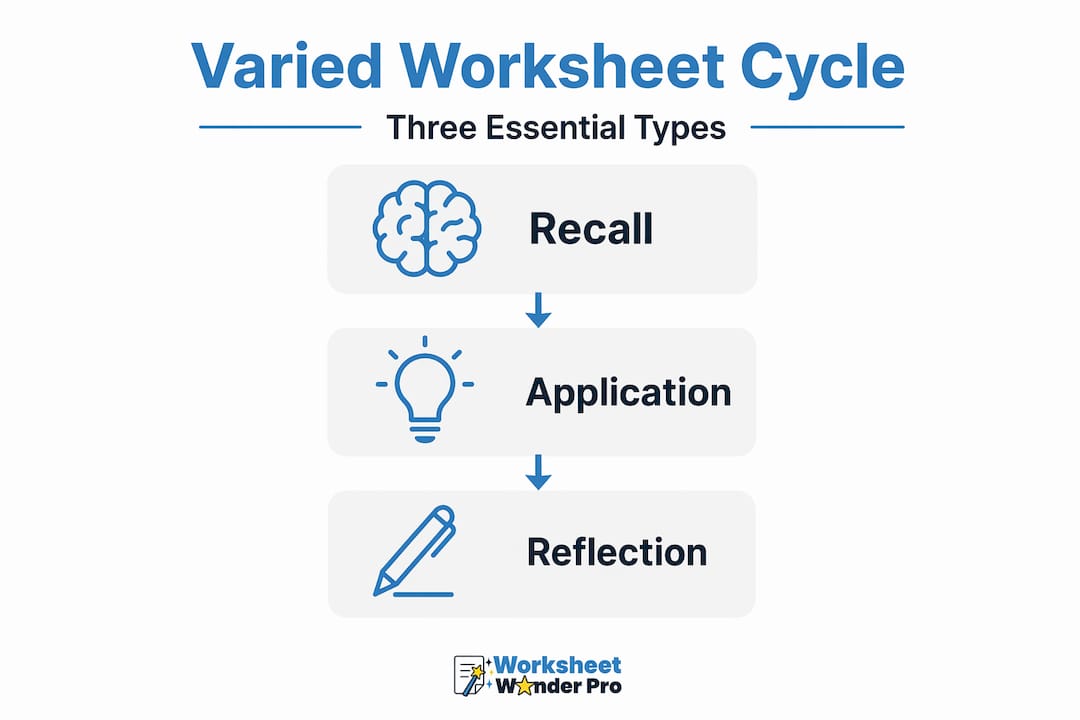
Pro Tip: Rotate at least three worksheet formats within a single unit: one for recall, one for application, and one for reflection. This alone addresses multiple cognitive levels without requiring a complete redesign of your materials.
Evidence on worksheet variety and thinking skills
The data on this topic is clear. A meta-analysis of 47 studies found a large positive effect of worksheets on creative and critical thinking skills, with an effect size of 1.960 and a correlation of approximately 0.498. That is a strong signal. But the key detail is that these were not random worksheet packets. They were validated, higher-order thinking worksheets designed with intentional variety.
| Study focus | Finding | Outcome measure |
|---|---|---|
| Meta-analysis of 47 studies | Large positive effect on critical and creative thinking | Effect size: 1.960 |
| Differentiated contextual worksheets | High design validity and moderate numeracy gains | N-Gain: 0.51, validity: 97.3% |
| Active learning vs. lecture instruction | Student-centered worksheets produce larger conceptual gains | Outperformed traditional methods |
Differentiated worksheets designed for visual, auditory, and kinesthetic learners showed 97.3% design validity and a moderate numeracy gain score of 0.51 in junior high students. That is not a marginal improvement. It reflects what happens when format is matched to learner profile.
The effects of varied worksheets on engagement are equally documented. Worksheet-centered active learning produces measurably larger gains than lecture-heavy instruction, particularly in conceptual understanding. When students move through different worksheet formats within a unit, they encounter content from multiple angles. That repetition with variation is what strengthens retention.
Expert review and student feedback also matter in validating worksheet design. A well-designed worksheet that has been reviewed for reading level, clarity, and cognitive challenge consistently outperforms one that was assembled quickly. The format does not need to be elaborate. It needs to be purposeful.
Common worksheet design mistakes
Knowing why diverse worksheets boost performance is only part of the picture. Recognizing what fails is equally important. These are the most common problems educators and parents run into:
- Worksheets as busywork. Without inquiry or pedagogical purpose, worksheets flatten curiosity and reduce critical thinking rather than building it.
- Missing scaffolding. Jumping from simple recall to complex application without intermediate steps overwhelms students and leads to disengagement.
- No feedback loop. Worksheets without feedback become low-engagement tasks where students complete the page but do not learn from errors.
- Inappropriate reading level. Instructions that are too complex for the target age group confuse learners before they even begin the task.
- Overloaded design. Too many questions, fonts, images, or instructions on a single page increases cognitive load and reduces completion quality.
Thinking maps and sketchnoting are worth noting here. Visual knowledge construction outperforms rote worksheet activities for diverse learners. That does not mean abandoning worksheets. It means integrating them alongside these tools to create a richer learning environment.
Pro Tip: Before distributing any worksheet, ask: What will students do with what they produce here? If the answer is "hand it in and move on," redesign the task to include a discussion prompt, a self-check component, or a peer review step.
For a closer look at what to avoid, the guide on worksheet design pitfalls covers the most frequent errors with specific fixes.
Practical strategies for varied worksheet use
Worksheet variety and student engagement grow together when the design follows a clear sequence. Here is how to structure that in practice:
- Start with recall formats. Fill-in-the-blank and matching tasks activate prior knowledge and set the foundation for more complex work.
- Move to application formats. Word problems, scenario analysis, and short-answer tasks ask students to use what they know in context.
- Introduce reflection components. Self-assessment rubrics or "what I still need to practice" sections build metacognitive awareness and close learning gaps.
- Pair worksheets with discussion. Oral review of worksheet responses turns a solo task into an active learning moment.
- Use digital and printable formats together. Interactive digital worksheets allow for immediate feedback, while printable versions support hands-on practice and annotation.
Varying the representational channel matters too. Vary worksheet versions by cognitive demand and representational channel while keeping learning goals constant. A visual learner benefits from diagram-based tasks. A kinesthetic learner benefits from cut-and-sort activities. The goal stays the same. The format shifts.
For teachers working across subjects, project-based worksheet formats offer one of the strongest bridges between structured practice and open-ended thinking. They work especially well when paired with collaborative tasks or student-led discussion. Resources like those from Korean Explorer show how student-centered activity design translates across languages and subject areas.
Balancing worksheet use with open-ended tasks like collaborative projects or thinking maps prevents over-reliance on any single format. A comprehensive overview of types of classroom worksheets can help educators identify which formats serve which instructional purposes.
My take on worksheet variety in practice
I have spent years watching educators use worksheets as a default rather than a deliberate tool. The pattern is predictable. A class gets a packet, students complete it, it gets graded, and the cycle repeats. Very little of that sticks.
What I have found works is treating each worksheet as one piece of a larger instructional sequence. When I align the format to a specific learning goal and the student's current level, the worksheet becomes a diagnostic and a teaching tool at the same time.
The most concrete improvement I have seen comes from differentiation. Giving one student a diagram-based task and another a written analysis of the same concept, both covering the same standard, produces better outcomes than giving everyone the same page.
The uncomfortable truth is that more worksheets do not mean more learning. Pedagogy and purposeful design matter far more. The moment I stopped measuring effort by the number of worksheets and started measuring it by the variety and quality of formats, I saw real shifts in student engagement and retention.
— Pamela
Create varied worksheets with Worksheetwonderpro
Worksheetwonderpro is built for educators and homeschool families who want to put the principles in this article into practice without spending hours on design.
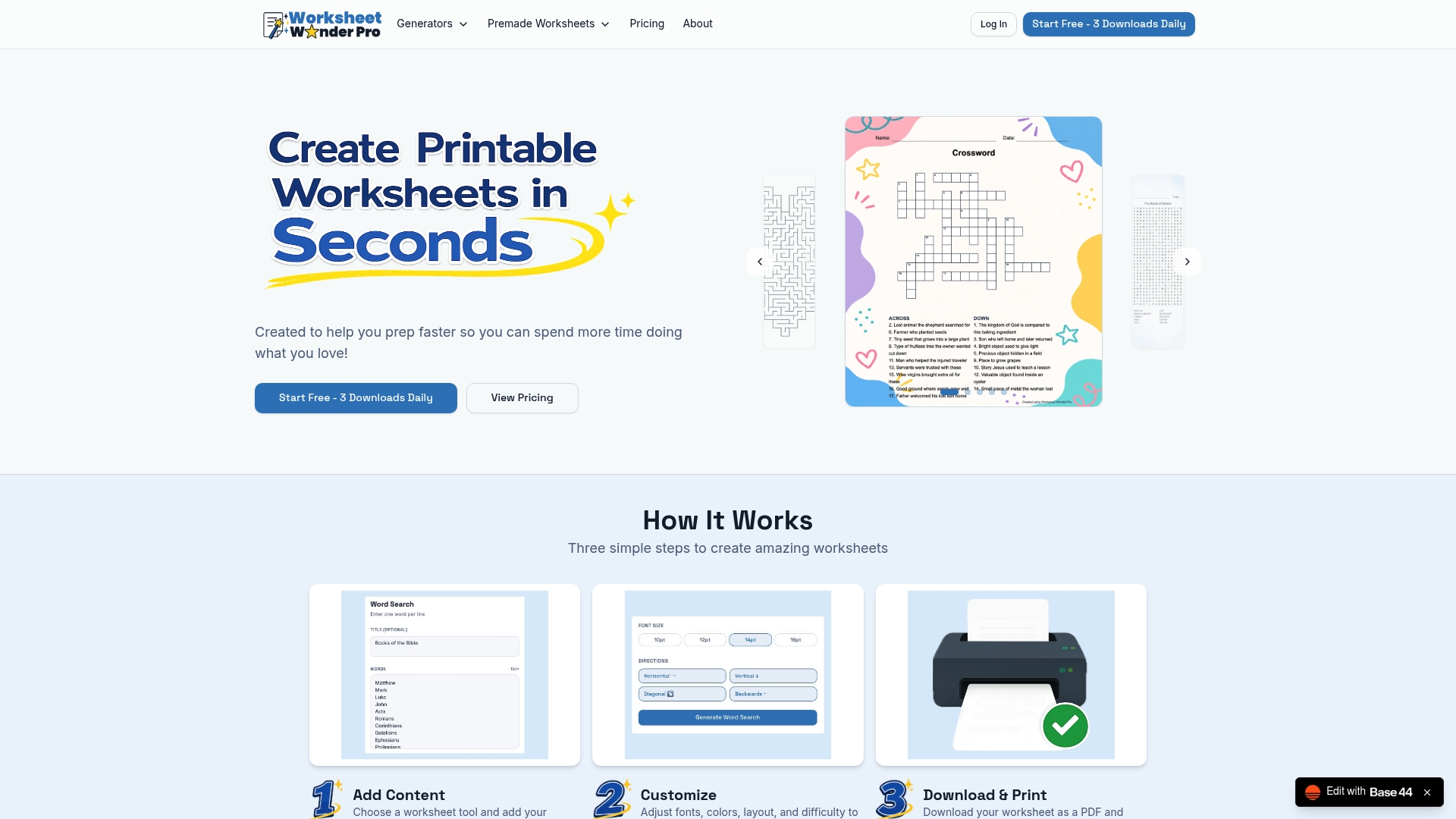
The platform supports differentiated worksheet creation across multiple formats, from interactive maze activities to structured recall tasks, all designed to align with active learning principles. Teachers can build custom worksheets or browse premade worksheet collections organized by subject and skill level. For educators who need advanced options, the professional tier adds custom design capabilities that support the full range of worksheet variety described in this article.
FAQ
Why does worksheet variety improve student outcomes?
Varied worksheet formats engage different cognitive processes, prevent disengagement from repetitive tasks, and support differentiated learning. Research shows a strong positive effect on critical and creative thinking when students work with intentionally designed, varied worksheets.
How many worksheet types should teachers use in a unit?
Using at least three formats per unit, such as recall, application, and reflection, covers multiple cognitive levels and supports better retention than using a single format repeatedly.
What makes a worksheet ineffective?
Worksheets become ineffective when used without instructional context, feedback, or scaffolding. Poor reading level alignment and overloaded page design also reduce learning value significantly.
Can worksheet variety help students with different learning styles?
Yes. Differentiated worksheets tailored to visual, auditory, and kinesthetic learners show measurable gains in both engagement and numeracy, with a validity score of 97.3% in documented studies.
How does feedback improve worksheet outcomes?
Feedback paired with worksheets guides students toward correct strategies and transforms a passive task into active learning. Without feedback, even well-designed worksheets produce limited instructional gains.