
Teachers and ministry leaders spend real time searching for examples of project-based worksheets that actually work in their settings. Generic printables fall short. What makes a project-based worksheet different is the built-in structure for inquiry, creation, and presentation. This article covers key selection criteria and walks through specific, tested examples across grade levels and contexts, from pumpkin math in elementary classrooms to a four-week social studies investigation in high school. Each example includes what subjects it covers, how long it takes, and what students produce at the end.
Table of Contents
- Key criteria for selecting project-based worksheets
- Seasonal and cross-curricular elementary projects
- A cross-curricular sneaker design project for grades 3-5
- Scaffolded social studies project for high school students
- Comparing project-based worksheet examples
- One thing most teachers get wrong about these worksheets
- Design and create your own project worksheets with Worksheet Wonder Pro
- Frequently asked questions
Key Takeaways
| Point | Details |
|---|---|
| Multi-step process | Effective project-based worksheets guide students through identifiable, scaffolded steps from question formulation to presentation. |
| Cross-curricular integration | Worksheets that integrate subjects like math, science, and language arts enhance engagement and learning depth. |
| Authentic audience | Projects culminating in presentations to real audiences motivate students and provide meaningful feedback. |
| Scaffolding | Breaking projects into weekly manageable checkpoints prevents student overwhelm and fosters ownership. |
| Customization tools | Using editable templates and tools allows teachers to tailor worksheets to their students’ unique contexts and skills. |
Key criteria for selecting project-based worksheets
Not every worksheet labeled "project-based" is worth your time. Effective project worksheets share a consistent set of features that separate them from standard fill-in-the-blank tasks.
Alignment with standards and skills. Project-based learning activities should connect to content standards and also build 21st-century skills like collaboration, communication, and critical thinking. A worksheet that covers fractions while requiring students to budget for a business idea does more than a standalone drill sheet.
Open-ended, real-world questions. Effective project worksheets prompt students to investigate rather than recall. Questions like "What design would make the most durable shoe under $50?" push students to apply knowledge rather than retrieve it.
Scaffolded steps. Long projects fail when students face a blank page and a deadline. Quality worksheets break the work into manageable stages with checkpoints. Each step builds on the last, so students never feel lost.
Authentic audiences. Projects must culminate in a presentation to an authentic audience following a structured multi-step process. Sharing work with peers, parents, or community members raises the stakes and the quality of output.
Clear rubrics. The worksheet set should assess both process (research, drafting, revision) and final product. Rubrics make expectations visible before students start, not after.
Here is a quick checklist when evaluating sample project worksheets:
- Does it connect to grade-level standards?
- Does it include at least one open-ended driving question?
- Are tasks broken into clear, sequenced steps?
- Is there a defined final product or presentation?
- Does it include or allow for a rubric?
Pro Tip: Before adopting any project-based teaching resource, run it through this checklist yourself. If it fails two or more criteria, the worksheet likely needs editing before use. Project-based learning tools can help you adjust templates quickly.
Seasonal and cross-curricular elementary projects
Elementary students respond well to themes tied to the time of year. Seasonal project-based learning activities give students a familiar anchor while building real academic skills across multiple subjects.

Studentreasures provides monthly projects like Pumpkin Math and Measurement and Weather Pattern Investigation that span one week to one month and culminate in classbooks. These classbooks become a published final product that families can hold and read, which dramatically increases student investment in the work.
Some strong examples of creative project worksheet examples for elementary grades include:
- Pumpkin Math and Measurement: Students estimate, measure, and record data about pumpkins, then write about their findings. Covers math, science observation, and expository writing.
- Weather Pattern Investigation: Students track and graph local weather over several weeks, then present conclusions. Connects science standards with data literacy and language learning activities for dual-language classrooms.
- Pollinator Garden Design: Students research local pollinators, design a garden layout on a grid, and write persuasive letters to the school principal asking for a real garden. Covers science, math, and writing simultaneously.
A typical workflow for these projects looks like this:
- Introduce the driving question with the worksheet prompt
- Students complete research or observation tasks over days one through three
- Draft written responses or visual products on days four and five
- Peer review using the included checklist
- Assemble final classbook pages or display materials
- Present to classmates, parents, or another class
Cross-curricular integration is the real strength here. When a student measures a pumpkin's circumference and writes a paragraph about it, two standards are covered in one activity.
Premade seasonal worksheets offer ready-to-use versions of these formats without the planning time.
A cross-curricular sneaker design project for grades 3-5
The "Design a Sneaker" project is one of the most well-structured examples of project-based worksheets available for upper elementary students. This PBL set includes reading passages, math budgeting sheets, design templates, and culminates in student presentations to peers.
It covers nine scaffolded steps across two to four weeks:
- Read the introductory passage about the shoe industry
- Answer comprehension questions tied to reading standards
- Research material costs using the provided price list
- Complete the budget worksheet to determine shoe cost
- Calculate profit margin using basic multiplication and subtraction
- Select design elements from the template library
- Draw and label the final sneaker design
- Write a short pitch explaining the design and its price point
- Present the poster to the class
Here is how this project compares across key subject areas:
| Subject area | What the worksheet covers |
|---|---|
| Math | Budgeting, multiplication, profit/loss |
| Reading/ELA | Informational text, comprehension questions |
| STEM | Materials science, functional design |
| Business/economics | Cost, pricing, consumer needs |
| Art | Design templates, color and layout choices |
What makes this set work as a worksheet ideas for projects resource is the combination of subjects without sacrificing depth in any one area. Students do real math. They read a real informational text. They make design decisions with constraints.
Pro Tip: Use the editable math sheets to adjust numbers for your grade's skill level. A third-grade class may work with whole numbers only, while fifth graders can handle decimals and percentages in the same budget sheet. Good worksheet creation tools make those edits fast.
Scaffolded social studies project for high school students
High school project-based worksheets work best when they build student ownership over time rather than handing them a final task at week four. Edutopia details a four-week scaffolded project with weekly tasks including question design, source analysis, thesis revision, and reflection for AP and standard social studies courses.
The weekly structure looks like this:
- Week one: Students choose an AP theme and write three initial research questions. The worksheet guides them through narrowing questions from broad to specific.
- Week two: Students locate and annotate two primary and two secondary sources. The worksheet includes source evaluation criteria.
- Week three: Students draft a working thesis and revise it based on evidence gathered. Peer feedback forms are included.
- Week four: Students write a final reflection paper connecting their research to exam preparation, noting what they would investigate further.
Key features of effective scaffolding project worksheets at this level include:
- Student-selected topics within teacher-defined parameters, increasing motivation
- Weekly check-in prompts that prevent last-minute scrambling
- Thesis revision built into the process, not treated as a one-shot task
- Metacognitive reflection at the end, asking students what they learned about their own thinking
This format works especially well for ministry leaders running youth Bible study or confirmation programs. Replace AP themes with scriptural themes. The same scaffold, same skills, different content.
Comparing project-based worksheet examples
The table below summarizes the key features of the project worksheet options covered in this article.
| Project | Grade level | Duration | Subjects covered | Final product |
|---|---|---|---|---|
| Pumpkin Math and Measurement | K-2 | 1 week | Math, science, writing | Classbook page |
| Weather Pattern Investigation | 2-4 | 2-3 weeks | Science, data literacy | Classbook or poster |
| Pollinator Garden Design | 3-5 | 2 weeks | Science, math, ELA | Persuasive letter |
| Design a Sneaker PBL | 3-5 | 2-4 weeks | Math, ELA, STEM, business | Presentation poster |
| Social Studies Investigation | 9-12 | 4 weeks | Social studies, ELA, research | Reflection paper |
A few patterns are worth noting when reviewing project worksheet options:
- Elementary projects favor shorter durations and a single thematic hook
- Upper elementary projects layer multiple subjects with creative output
- High school projects prioritize student agency, source work, and written analysis
- Ministry contexts can adapt any of these formats by substituting content themes
Match the project to your time constraints first, then your subject goals, then your students' independence level.
One thing most teachers get wrong about these worksheets
Most teachers treat project-based worksheets as a reward activity for after the test. Use them when there's extra time. Pull them out in May. That approach wastes the format entirely.
Project-based worksheets are most effective when they are the instruction, not a supplement to it. The sneaker design project does not review math. It teaches budgeting through budgeting. The social studies investigation does not practice thesis writing. It builds thesis skill through actual revision cycles.
The worksheet is the curriculum. When teachers treat it that way, students stop asking "when will we use this?" because the answer is visible in the work itself.
Design and create your own project worksheets with Worksheet Wonder Pro
Finding the right format is half the work. The other half is adapting it to your students. Worksheet Wonder Pro gives teachers and ministry leaders the tools to create or edit project-based worksheets without starting from scratch every time.
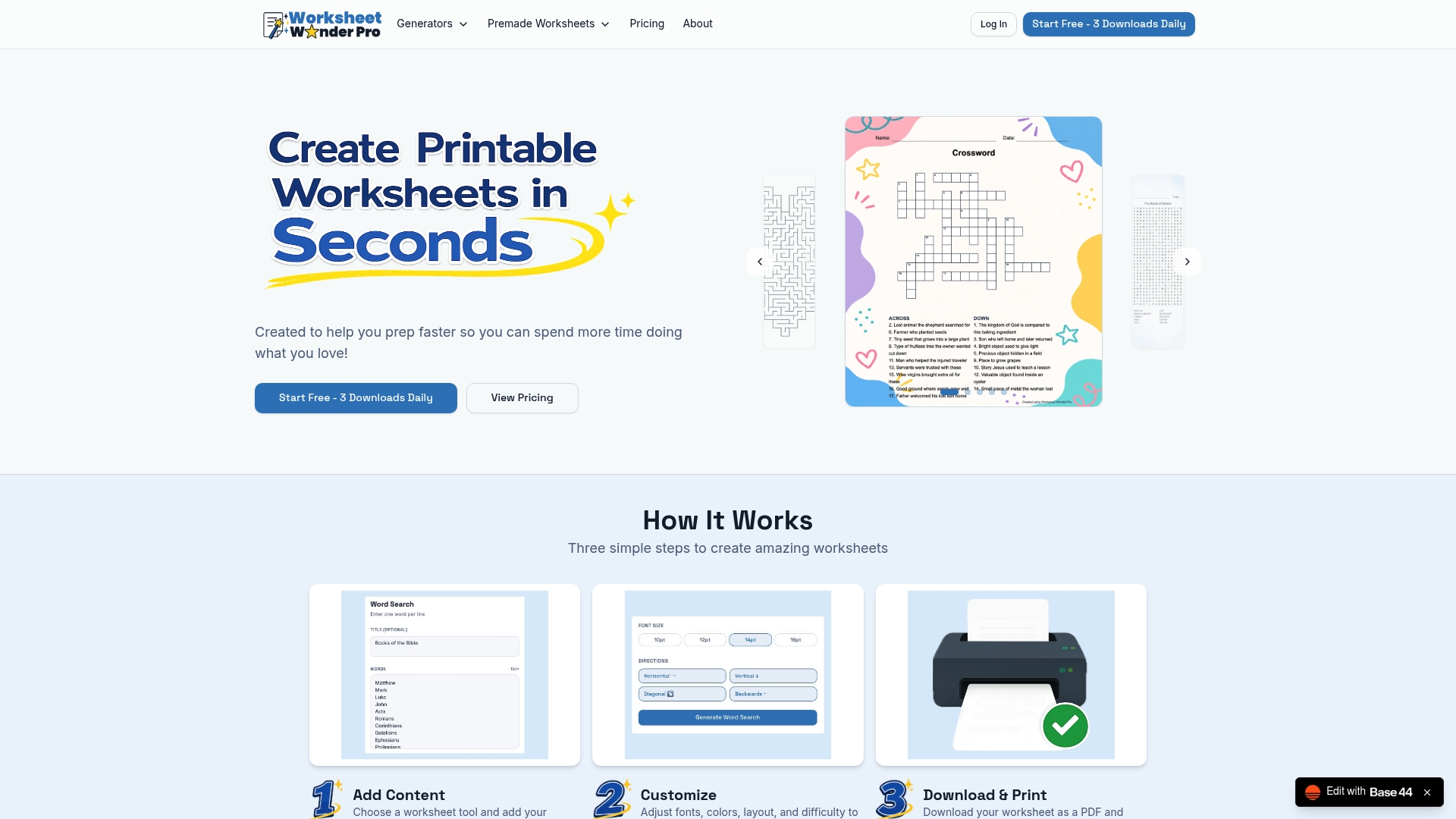
The platform includes editable templates, premade seasonal projects, and a worksheet builder designed for educators who need results fast. Whether you are designing a sneaker project for third grade or a four-week youth ministry investigation, the tools are built to match your pace. Visit Worksheet Wonder Pro to explore the full template library and creation tools available to educators today.
Frequently asked questions
What are project-based worksheets?
Project-based worksheets guide students through multi-step, real-world projects that promote critical thinking, collaboration, and presentation skills. They differ from traditional worksheets because they engage students in completing complex, real-world tasks with a defined final product.
How long do project-based worksheets usually take to complete?
Durations vary from one week to a full semester depending on the scope. Monthly elementary projects typically last one week to one month, while high school projects often run four weeks or longer with built-in checkpoints.
How can I scaffold project-based worksheets to keep students engaged?
Use weekly checkpoints with clear tasks like question design, source analysis, and reflection. Scaffolding weekly checkpoints prevents disengagement and builds student ownership across the full project duration.
Are there tools to customize or create project-based worksheets?
Yes. Platforms like Worksheet Wonder Pro offer tools and editable templates that allow teachers to adapt or create project-based worksheets tailored to their specific classroom or ministry needs.