Word banks seem like a simple, universally helpful tool. Drop a list of words on a worksheet, and students have what they need to complete the task. The reality is more layered. The role of word banks in worksheets goes beyond basic support. Used well, they build vocabulary and reduce cognitive load. Used carelessly, they can train students to copy rather than think. This guide breaks down what word banks actually do, where they fall short, and how educators can design worksheets that use them to build genuine language skills.
Table of Contents
- Understanding word banks and their purpose in worksheets
- Benefits and challenges of word banks in vocabulary learning
- How to maximize the effectiveness of word banks in worksheets
- Comparing word banks with other scaffolding tools in worksheets
- Practical tips for educators: implementing word banks to enhance vocabulary through worksheets
- A nuanced take on the role of word banks in vocabulary learning
- Enhance your worksheets with Worksheet Wonder Pro's word bank tools
- Frequently asked questions
Understanding word banks and their purpose in worksheets
A word bank is a curated list of words or phrases provided on a worksheet to support students during writing or reading tasks. These lists can appear as physical word cards, printed lists alongside activities, or digital databases embedded in interactive tools. The format varies, but the function stays the same: give students vocabulary access at the moment they need it.
Vocabulary support in worksheets is especially important in early literacy. Word banks are most common in Kindergarten through Grade 2, where students are still building the foundational language they need to express ideas in writing. Word banks at this stage act as scaffolding, a temporary support structure that holds up the learning until the student can stand on their own.
Word banks serve several functions in worksheets:
- Vocabulary enrichment: Introduce new or domain-specific words in context
- Language support: Assist English language learners and students with learning differences
- Quick reference: Reduce interruptions during independent work
- Writing aid: Help students focus on sentence structure rather than word recall
Word banks serve as a critical scaffolding tool by providing a visual reference that reduces cognitive load, helping early writers focus on sentence structure and vocabulary. That reduction in mental demand is the core value. Students are not spending energy searching their memory for a spelling or a term. They are thinking about how to use language meaningfully.
Word banks are also adaptable for older students who need support with academic language, technical vocabulary, or subject-specific terminology across content areas.

Benefits and challenges of word banks in vocabulary learning
The immediate benefit of word banks is clear. Students get vocabulary access right when they need it, which keeps them writing and engaged rather than stuck or frustrated. This is especially useful for English language learners and students who have strong ideas but limited word recall.
Key benefits include:
- Reduced cognitive load during writing tasks
- Increased writing output among struggling students
- Vocabulary exposure through repeated encounters with new words
- Confidence support for students who freeze during open-ended tasks
But the risks deserve equal attention.
"While word banks offer immediate support, they can create dependency, requiring educators to plan for gradual removal to build student independence." — Edutopia
The dependency issue is real. Students who rely on word banks for every task may not develop the internal vocabulary retrieval skills they need for independent writing, standardized assessments, or class discussions. Word banks provide "in-the-moment" support but don't build long-term independence and should be treated as temporary bridges.
The solution is a fading strategy. This means designing word bank scaffolding tools with a plan to reduce or remove them as student proficiency grows. Start with a full word bank, then shift to a partial list, then to categories without specific words, and finally to no list at all.
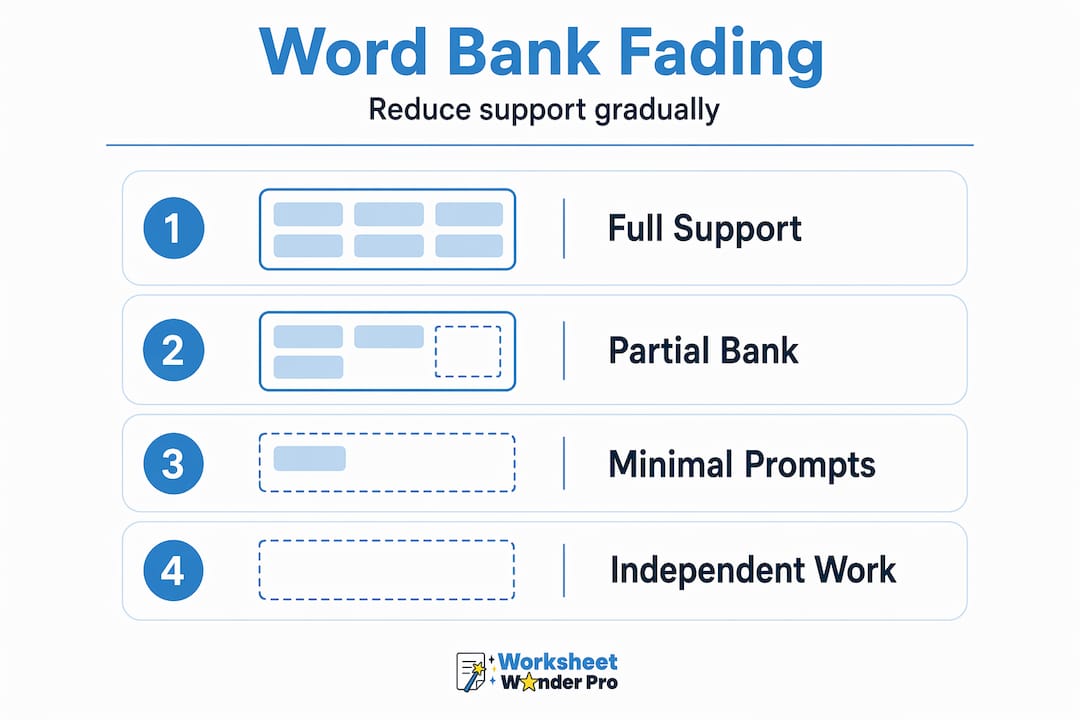
Pro Tip: Never use word banks as a permanent fixture on every worksheet. Rotate tasks so some activities require students to retrieve vocabulary without any list provided.
How to maximize the effectiveness of word banks in worksheets
Designing word banks for actual vocabulary development, not just task completion, requires intentional choices. Here is a practical process:
- Include contextual clues alongside words. Add a synonym, antonym, or brief usage example next to each word. This gives students more than a label. It gives them meaning.
- Require immediate use in sentences. The most effective word banks require students to use words in sentences or real-life contexts immediately rather than learning in isolation.
- Model word bank use explicitly. Teachers should model word bank and sentence frame use explicitly before expecting independent student use. This means thinking aloud, choosing a word, and constructing a sentence in front of the class.
- Embed sentence starters. Combine word banks with sentence frames like "The character felt ___ because ___" to push students toward academic language while still generating their own content.
- Plan scaffold removal. Mark which activities in your unit will use a full word bank, a reduced list, and no list at all. Build the progression into your lesson sequence from the start.
These steps work for effective word bank worksheet examples across grade levels. They also apply to interactive language learning activities in multilingual settings, where vocabulary scaffolding is essential for language acquisition.
Pro Tip: After a writing task using a word bank, ask students to circle the three words they found most useful and explain why. This brief reflection builds metacognitive awareness around vocabulary.
Comparing word banks with other scaffolding tools in worksheets
Word banks do not operate in isolation. They are one tool in a broader scaffolding system. Understanding how they compare to other supports helps educators choose the right combination.
| Scaffolding tool | What it provides | Student responsibility | Best used when |
|---|---|---|---|
| Word bank | Vocabulary list | Word selection and usage | Students need lexical support |
| Sentence frame | Sentence structure | Core content and ideas | Students need syntactic support |
| Embedded prompt | Language and context cue | Full sentence construction | Students need light guidance |
| Visual aid | Concept reference | Language and structure | Students need concept clarity |
Key distinctions:
- Word banks give students the vocabulary but require them to make meaning
- Sentence frames give students the structure but require them to supply vocabulary and ideas
- Embedded scaffolds guide academic language use without completing the thought
Embedded scaffolds prompt students to use academic language while requiring them to generate core content themselves, which supports independence over time. Combining a word bank with a sentence frame, for example, gives both vocabulary and structure, which is powerful for early writers or English learners.
Visit scaffolding tool comparisons to see how different worksheet formats support each scaffold type. For more advanced options, explore advanced scaffold options designed for upper grade and specialized instruction.
Pro Tip: Use a fading strategy across a unit. Week one uses all three supports together. By week four, students work with one or none.
Practical tips for educators: implementing word banks to enhance vocabulary through worksheets
After the design work, implementation makes the difference. These strategies help word banks build actual vocabulary retention.
- Schedule daily or weekly word bank review. Brief five-minute challenges at the start of class, such as "use three words from this week's bank in a conversation," extend vocabulary exposure beyond the worksheet.
- Assign synonym swaps. Give students a sentence and ask them to replace a word with one from the word bank that carries a similar meaning. This builds word relationships, not just word recognition.
- Use word banks across subject areas. The same vocabulary word appearing in a reading passage, a discussion prompt, and a homework activity creates the repeated exposure that supports retention. Vocabulary learning improves when students revisit words frequently using diverse methods like sentence creation and synonym matching.
- Monitor independence regularly. Every two to three weeks, assign one activity with no scaffolding. Observe which students struggle. Use that data to decide whether to continue fading or re-introduce support.
- Extend to homework. Send the word bank home with a short activity. Ask parents to use the words in conversation or simple writing tasks.
For more on vocabulary retention strategies, see how grammar and vocabulary worksheets work together to build language skills. Ready-made options are available as vocabulary worksheet resources for educators who need to move quickly.
Pro Tip: Collaborate with parents and caregivers. A short note explaining the word bank and asking them to use two words at dinner can significantly extend a student's weekly vocabulary exposure.
A nuanced take on the role of word banks in vocabulary learning
Word banks are one of the most misused tools in worksheet design. The problem is not that educators use them. The problem is that many use them without a plan to stop.
Handing every student a word bank for every task shifts the cognitive work from the student to the list. Over time, students learn to scan and copy rather than retrieve and use. That is not vocabulary development. That is task completion. The distinction matters because educators should view word banks as temporary bridges and actively plan for the gradual removal of supports to foster long-term vocabulary independence.
The deeper issue is that vocabulary development requires meaningful use, not exposure. A student who sees the word "persistent" on a word bank fifteen times may never internalize it. A student who uses it in a sentence about a character, then again in a discussion, then in a self-assessment has a real chance of owning that word.
Word banks work best when they are part of a planned progression, paired with sentence frames, embedded prompts, and regular scaffold removal. They are a starting point for long-term language skill building, not a permanent feature. Design with the exit in mind from the beginning.
Enhance your worksheets with Worksheet Wonder Pro's word bank tools
Worksheet Wonder Pro gives classroom teachers, homeschoolers, and ministry leaders a practical set of tools for building vocabulary-rich worksheets. The platform supports integrated word banks, sentence starters, and embedded vocabulary prompts, making it straightforward to design activities that scaffold student learning without doing all the thinking for them.
With access to premade vocabulary worksheets and a full set of worksheet creation tools, educators can build materials that match their students' current level and plan the scaffold fading steps right into the design. Whether starting from scratch or adapting existing content, the Worksheet Wonder Pro platform supports the full process from first draft to independent student use.
Pro Tip: Use the platform's scaffold settings to build two versions of the same worksheet, one with a full word bank and one without. Assign them based on student readiness and track progress toward the independent version.
Frequently asked questions
What is the primary role of a word bank in educational worksheets?
The primary role of a word bank is to provide vocabulary support during writing or reading tasks, giving students a curated list that reduces cognitive load and supports language use. Word banks serve as a critical scaffolding tool that helps early writers focus on sentence construction rather than word recall.
Can using word banks too much hinder student learning?
Yes. Excessive use of word banks can create dependency and limit students' ability to produce vocabulary independently, so educators should plan to gradually remove these supports over time.
How can educators make word banks more effective?
Educators can increase effectiveness by pairing word banks with sentence frames, requiring immediate use in writing, and modeling word selection explicitly. The most effective word banks require students to use words in sentences or real-life contexts rather than just recognition tasks.
What are embedded scaffolds and how do they relate to word banks?
Embedded scaffolds are prompts like sentence starters that guide students toward academic language while still requiring them to supply the core content. Embedded scaffolds prompt students to express ideas using specific sentence structures, which complements word banks by adding structural support alongside vocabulary access.
When should educators begin to fade word banks and scaffolds?
Educators should begin fading supports once students consistently demonstrate the ability to use target vocabulary and sentence structures without prompting. Word banks should be treated as temporary tools and removed gradually as students gain proficiency to support true language independence.