
Choosing the right worksheet is harder than it looks. There are many types of classroom worksheets available, and each one serves a different teaching goal. A vocabulary drill does not replace a creative writing prompt. A quiz is not the same as an exit ticket. Worksheets serve varied functions from reinforcing skills to assessing understanding and sparking creativity, which means selecting the wrong type can leave students disengaged or leave learning gaps unaddressed. This guide breaks down the main educational worksheet categories by function so teachers and homeschool parents can match format to purpose.
Table of Contents
- How to evaluate types of classroom worksheets
- Practice and assessment worksheets: core tools for skill reinforcement
- Interactive and creative worksheets: boosting engagement and critical thinking
- Worksheets for special needs and thinking skill development
- Exit tickets: quick formative assessment in worksheet form
- Comparing worksheet types: which fits your teaching goals?
- Why rethinking worksheet use is key to deeper learning
- Explore Worksheet Wonder Pro: your partner in creating versatile worksheets
- Frequently asked questions
Key Takeaways
| Point | Details |
|---|---|
| Worksheet functions vary | Worksheets serve different educational purposes including practice, assessment, creativity, and support for special needs. |
| Select by purpose | Choosing worksheets based on your instructional goal improves student engagement and learning outcomes. |
| Interactive and creative options | Digital interactive and creative worksheets enhance motivation beyond traditional formats. |
| Use thinking maps | Thinking maps foster deeper thinking and curiosity, complementing or replacing routine worksheets. |
| Exit tickets provide quick feedback | Brief, formative exit tickets help teachers adjust instruction efficiently at lesson close. |
How to evaluate types of classroom worksheets
Not all worksheet types work equally well for every lesson. Before selecting a worksheet, consider four key criteria.
- Educational purpose. Identify what the worksheet needs to do. Is it for reinforcing a skill, measuring understanding, motivating students, or supporting access for diverse learners? Selecting worksheets based on educational purpose helps avoid the common mistake of using all worksheet types interchangeably.
- Delivery method. Decide whether print or digital delivery fits the learning environment. Some worksheet ideas for teachers work better on paper, while others benefit from digital interactivity.
- Developmental appropriateness. Match the worksheet's complexity to students' age and current skill level. A worksheet that is too simple loses attention. One that is too complex creates frustration.
- Instructional objective. The teacher's specific lesson goal should drive format selection. A lesson focused on recall calls for a different worksheet than one focused on analysis or creation.
Reviewing worksheet selection guidance by school type can also help narrow down the most effective formats for a given context.
Practice and assessment worksheets: core tools for skill reinforcement
Practice and assessment worksheets are the most common types of teaching materials found in classrooms. They serve two distinct but related purposes.
Practice worksheets focus on reinforcing concepts, while assessment worksheets help evaluate understanding and guide instruction. Common formats include:
- Practice worksheets: problem sets, fill-in-the-blank exercises, vocabulary builders, matching activities, and sentence completion tasks
- Assessment worksheets: short quizzes, unit tests, self-assessment checklists, and reflection prompts
- Delivery: both types work in print or digital formats depending on classroom setup
Both can function as printable student worksheets or as digital files shared through a learning platform. The key difference is intent. Practice worksheets build fluency through repetition. Assessment worksheets reveal what students actually retained.
Pro Tip: Use assessment worksheets formatively, meaning during instruction rather than only at the end of a unit. This gives real-time data to adjust lessons before students fall behind. Explore premade worksheets for practice to save preparation time across subjects.
Interactive and creative worksheets: boosting engagement and critical thinking
Beyond traditional formats, interactive and creative worksheets offer different engagement strategies for diverse learners.
Interactive worksheets use features like drag-and-drop and embedded quizzes to provide immediate feedback, making them especially effective in online or blended learning environments. Creative worksheets take a different approach. They include open-ended prompts, drawing tasks, project planning sheets, and storytelling activities.
Key characteristics of each type:
- Interactive worksheets: real-time feedback, self-paced, ideal for digital classrooms, support independent learning
- Creative worksheets: open-ended responses, student-generated content, support divergent thinking, work well for project-based learning
- Both types: support diverse learning styles and increase student motivation compared to standard drill formats
Creative classroom activity sheets encourage students to construct meaning rather than simply recall information. This distinction matters for building critical thinking skills over time. Teachers can access creative worksheet tools to build these formats quickly without starting from scratch.
Worksheets for special needs and thinking skill development
Specialized worksheets and thinking maps address two important areas that standard formats often miss.

Worksheets adapted for special needs use simplified language and clear visuals to improve comprehension and engagement. These printable student worksheets often include larger fonts, step-by-step instructions broken into smaller chunks, and picture supports alongside text.
Thinking maps are a distinct category. They are visual frameworks that target specific cognitive processes. Common types include bubble maps for describing, tree maps for classifying, flow maps for sequencing, and double-bubble maps for comparing. Introducing these progressively by grade level supports cognitive development in a structured way.
| Feature | Special needs worksheets | Thinking maps |
|---|---|---|
| Purpose | Improve access and comprehension | Develop specific cognitive skills |
| Format | Simplified text, visuals, structured layout | Visual diagrams with defined shapes |
| Cognitive impact | Reduces barriers to understanding | Builds higher-order thinking |
| Best for | Learners needing differentiated support | All grade levels, especially for analysis |
| Delivery | Print or digital | Print or digital |
Both options expand what subject-specific worksheets can accomplish when standard formats are not meeting student needs.
Exit tickets: quick formative assessment in worksheet form
Exit tickets are a specific type of classroom activity sheet used at the end of a lesson. Exit tickets contain 2 to 4 quick questions used at the end of lessons to collect actionable, ungraded data that supports instructional decisions.
Key features of exit tickets:
- Time: 3 to 5 minutes at lesson's end
- Focus: understanding checks and metacognitive reflection
- Stakes: low, ungraded, and formative rather than evaluative
- Common formats: 3-2-1 prompts (3 things learned, 2 questions, 1 connection), one-sentence summaries, or quick multiple-choice checks
Exit tickets differ from quizzes because the goal is not to assign a grade. The goal is to collect fast data so the next lesson can be adjusted. Teachers working with exit tickets in middle school settings find them especially useful for tracking concept gaps across a large student group.
Pro Tip: Create a standard exit ticket template for each subject but swap out the specific question each time. This keeps cognitive demand consistent while reducing the time spent on preparation.
Comparing worksheet types: which fits your teaching goals?
Functional classification of worksheets helps teachers match format to educational purpose, which directly improves learning outcomes. The table below consolidates the major types covered in this guide.
| Worksheet type | Purpose | Format | Cognitive demand | Best delivery |
|---|---|---|---|---|
| Practice | Skill reinforcement | Problem sets, fill-in-the-blank | Low to medium | Print or digital |
| Assessment | Evaluate understanding | Quizzes, tests, self-checks | Medium | Print or digital |
| Interactive | Engagement, feedback | Drag-and-drop, embedded quizzes | Medium | Digital |
| Creative | Exploration, expression | Open prompts, drawing, projects | Medium to high | Print or digital |
| Special needs | Access and comprehension | Simplified text, visuals | Varies | Print or digital |
| Thinking maps | Cognitive skill building | Visual diagrams | Medium to high | Print or digital |
| Exit tickets | Formative check | Short prompts, 2 to 4 questions | Low to medium | Print or digital |
For a deeper look at how format affects skill-building, the worksheet type comparison in grammar instruction offers a useful subject-specific example.
Why rethinking worksheet use is key to deeper learning
Worksheets are useful. They are also easy to overuse. Overreliance on worksheets can stifle curiosity and narrow thinking, while replacing some with thinking maps promotes active construction of knowledge.
The real issue is not the worksheet itself. It is what the worksheet asks students to do. Most practice and assessment worksheets ask students to retrieve or apply information. That is necessary but not sufficient for deep learning. When every lesson ends with a fill-in-the-blank sheet, students learn to comply rather than to think.
Thinking maps, sketchnoting, and structured discussion protocols give students ownership over how they organize and express ideas. These tools do not replace worksheets entirely. They fill the gaps that worksheets leave. A lesson might start with a thinking map to activate prior knowledge, use a practice worksheet for skill work, and close with an exit ticket. That sequence covers recall, application, and reflection in a single session.
Pro Tip: Blend enhanced worksheet strategies with visual tools and discussion routines. This combination builds a classroom culture where students engage with content rather than just complete tasks.
Explore Worksheet Wonder Pro: your partner in creating versatile worksheets
Putting these worksheet ideas into practice takes the right tools. Worksheet Wonder Pro gives teachers and homeschool parents access to a full range of worksheet formats in one place.
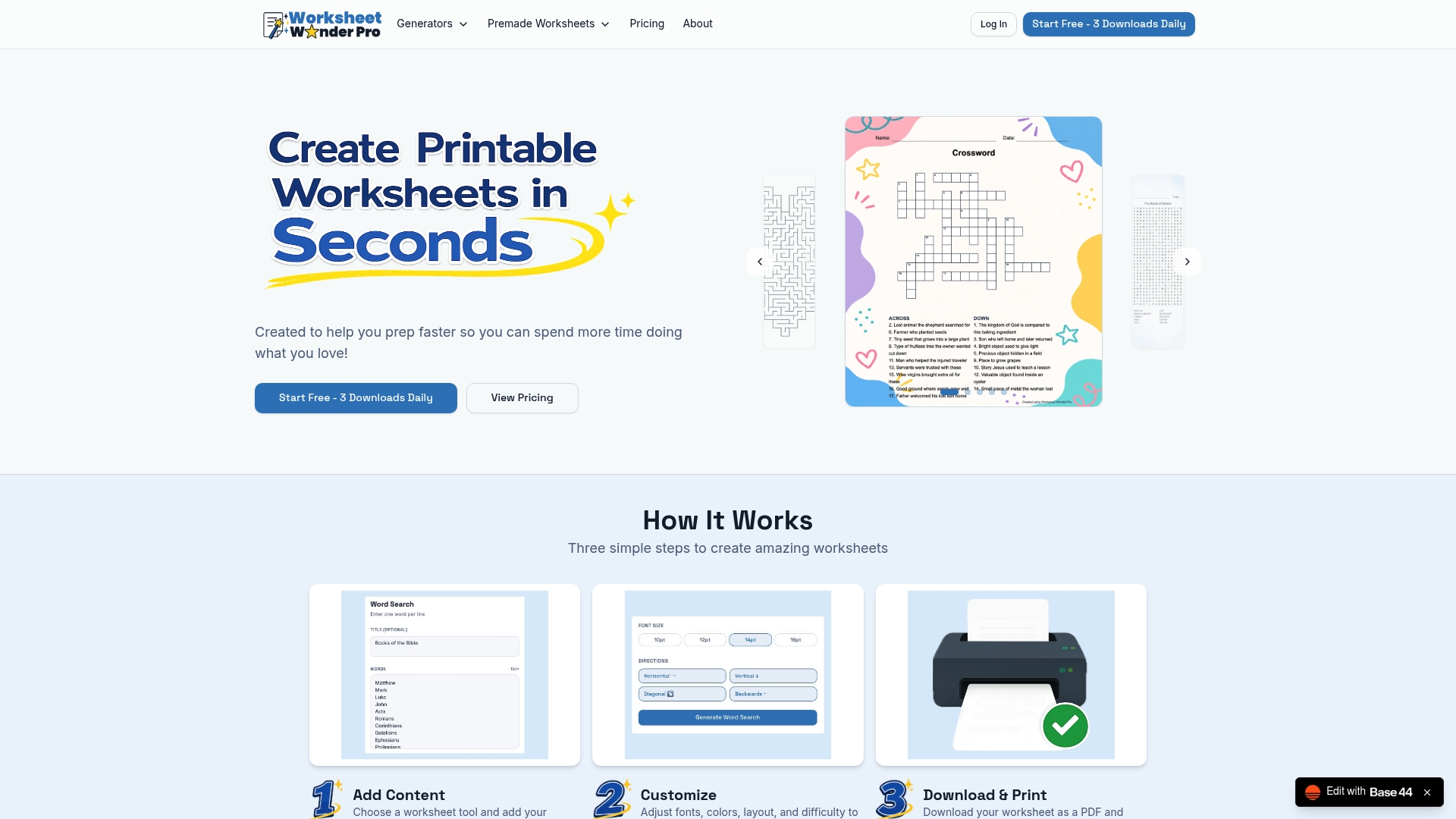
Use creative worksheet creation tools to build interactive and open-ended worksheets for any subject. Browse premade worksheet collections spanning practice, assessment, and creative types to reduce planning time. Templates support both print and digital delivery, making it easy to adapt materials for any classroom setup, including special needs learners and diverse grade levels.
Frequently asked questions
What are the main functional types of classroom worksheets?
The main worksheet types by learning function include practice worksheets for reinforcement, assessment worksheets for evaluation, interactive worksheets for engagement, creative worksheets for exploration, and worksheets adapted for special needs learners.
How do exit tickets differ from traditional quizzes?
Exit tickets are low-stakes formative tools that gather actionable data without grading, unlike quizzes which are typically summative and contribute to a student's grade.
Why should teachers integrate thinking maps alongside worksheets?
Replacing some worksheets with thinking maps encourages active knowledge construction and curiosity, which standard recall-based worksheets often do not support on their own.
Can interactive worksheets be used without digital tools?
Interactive worksheets typically rely on digital features like drag-and-drop and embedded quizzes, so they usually require a device, though some analog adaptations can incorporate hands-on activities that mirror interactive concepts.
How do worksheets support students with special needs?
Worksheets adapted for special needs use simplified language and visual structure to improve understanding and engagement, making content more accessible for diverse learners.