
Worksheets are defined as structured instructional materials that guide student activity toward specific learning goals. The role of worksheets in classroom settings extends beyond simple practice. When designed well and embedded in intentional lessons, they scaffold active participation, reinforce concepts, and give teachers real-time feedback on student understanding. Sources like Teachers Pay Teachers, curriculum publishers, and digital platforms have made worksheet access easier than ever. Yet research from Edutopia confirms that a worksheet is a material, not a lesson. Its impact depends entirely on how it is used.
How worksheets promote active learning and improve outcomes
Worksheets provide structured, focused tasks that move students from passive listening to active doing. That shift matters. A quantitative study found interactive worksheets correlate with math outcomes at R=0.450 (p=0.002), with worksheet use intensity explaining 20.2% of the variation in elementary student performance. That figure means roughly one fifth of measurable learning differences in that study traced back to how actively students engaged with their worksheets.
Multimedia enhancements push those results further. A quasi-experimental study with 72 science students found that animated video-assisted worksheets significantly improved problem-solving, motivation, and cognitive outcomes in 11th graders (p<0.01). Static fill-in-the-blank formats simply do not produce the same cognitive engagement.
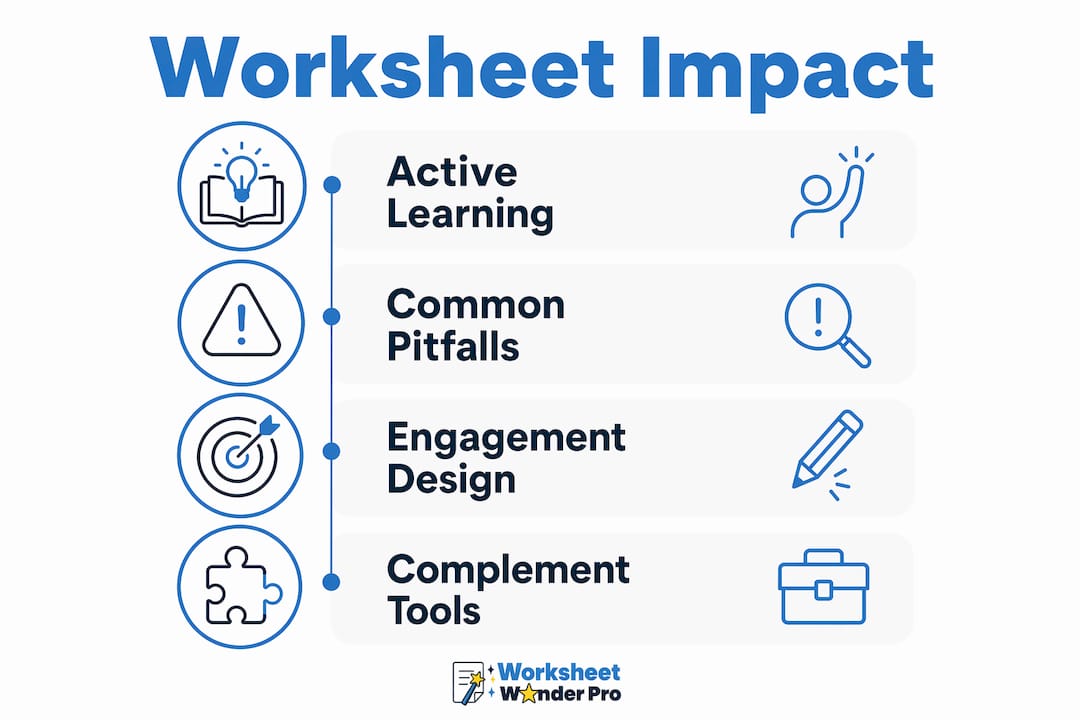
The benefits of classroom worksheets are strongest when the worksheet sits inside a broader lesson sequence rather than standing alone. Effective use follows a pattern:
- Model first. Demonstrate the concept before students attempt the worksheet independently.
- Guide before releasing. Walk through one or two items together to surface confusion early.
- Build in sharing. Ask students to discuss or present responses, which adds accountability and depth.
- Align to a goal. Every worksheet task should map to a specific learning target, not just fill time.
"Teachers should transform worksheets from 'material' to an integral part of a vibrant learning experience through intentional planning." — Edutopia
What are the most common pitfalls of classroom worksheets?
Worksheets become liabilities when they replace meaningful instruction rather than support it. ASCD warns that over-reliance on worksheets narrows thinking tasks, stifles curiosity, and disproportionately harms English language learners and struggling readers who face unclear directions or reading levels above their current ability.
The most frequent problems follow a predictable pattern:
- Busywork design. Worksheets filled with low-level recall questions keep students occupied but produce no real learning gain.
- No scaffolding. Handing out a worksheet without modeling or guided practice leaves struggling students guessing rather than thinking.
- Misaligned reading level. Directions written above a student's reading level create confusion that has nothing to do with the content being taught.
- Assessment substitution. Using worksheet completion as the primary evidence of learning misses the point. Accurate completion does not guarantee understanding.
Knowing whether errors reflect misunderstanding or unclear instructions requires embedded explanation prompts, not just answer blanks. A student who writes the wrong answer but explains their reasoning correctly has revealed something a simple checkmark never could.
Pro Tip: Before distributing any worksheet, read the directions aloud yourself and ask: could a student at the lower end of this class follow these without help? If not, revise the language before the lesson.
How to design worksheets for maximum student engagement
Worksheet design directly controls how much cognitive work students actually do. The types of classroom worksheets you choose and how you structure them shapes whether students think deeply or just fill boxes.

Chunking is the most underused design technique. Breaking multi-part worksheets into short segments with pauses for discussion maintains attention and gives teachers natural checkpoints to catch misconceptions before they compound. A single 20-question worksheet handed out at once signals to students that the goal is completion, not understanding.
| Design element | Effect on learning |
|---|---|
| Explanation prompts | Shifts focus from recall to reasoning and reveals depth of understanding |
| Word banks or thinking maps | Reduces cognitive overload for struggling learners without removing challenge |
| Multimedia embeds | Increases motivation and connects abstract content to concrete examples |
| Discussion checkpoints | Builds accountability and surfaces misconceptions mid-task |
Adding prompts that require explanation and reasoning is one of the highest-leverage changes a teacher can make. Reasoning and discussion prompts in a social studies worksheet redesign, for example, produced noticeably deeper student responses than the original recall-only version. The worksheet looked similar. The thinking it required was entirely different.
- Use visual scaffolds like thinking maps or graphic organizers for complex tasks.
- Vary worksheet formats across lessons to address different learning styles and prevent routine fatigue.
- Keep independent sections short enough to complete in one focused sitting.
Pro Tip: Add one "explain your thinking" line to every worksheet section. It takes 30 seconds to design and gives you far more diagnostic information than a correct answer alone.
What tools and strategies complement worksheet use?
Worksheets work best as one component in a broader instructional toolkit. ASCD recommends visual cognitive tools like thinking maps and sketchnoting as open-ended alternatives that foster curiosity, deeper understanding, and multi-modal engagement. These formats invite students to organize information in their own way rather than follow a predetermined structure.
Artful Thinking routines, developed at Harvard Project Zero, give students structured protocols for observation and interpretation that no fill-in-the-blank worksheet can replicate. Pairing a worksheet-based practice task with a sketchnoting activity on the same concept lets students consolidate knowledge through two different cognitive pathways.
Digital interactive worksheets add another layer. Formats with embedded feedback and multimedia components shift cognitive engagement from passive recall to active processing, which increases both motivation and retention. For language learners specifically, interactive formats in language learning contexts show measurable gains in engagement compared to static text-only materials.
The practical balance looks like this:
- Use worksheets for structured practice, vocabulary reinforcement, and step-by-step problem solving.
- Use thinking maps and sketchnoting for concept synthesis and open-ended exploration.
- Use project-based formats, such as those found in project-based worksheet examples, for deeper inquiry and student-driven work.
- Use digital interactive formats when motivation or engagement is low and multimedia support is available.
Key takeaways
Worksheets improve learning outcomes when embedded in intentional instruction, designed with reasoning prompts, and paired with complementary tools rather than used as standalone tasks.
| Point | Details |
|---|---|
| Embed in lesson sequences | Worksheets paired with modeling and guided practice produce stronger outcomes than standalone tasks. |
| Use interactive formats | Interactive worksheets correlate with improved math outcomes at R=0.450, explaining 20.2% of performance variation. |
| Avoid busywork design | Low-level recall questions keep students busy but do not produce measurable learning gains. |
| Add reasoning prompts | Explanation prompts reveal student thinking and give teachers diagnostic data beyond correct answers. |
| Complement with open-ended tools | Thinking maps and sketchnoting extend learning beyond what structured worksheets alone can achieve. |
Worksheets as one tool, not the whole toolbox
I have seen teachers hand out worksheets with the best intentions and watch students disengage within minutes. The worksheet was not the problem. The problem was that it asked students to recall facts they had never been taught to reason about. That is the trap most educators fall into without realizing it.
My honest view is that worksheets are underestimated when used well and overused when teachers are under pressure. A well-designed worksheet with a reasoning prompt and a discussion checkpoint is a genuinely powerful diagnostic tool. It tells you exactly where a student's thinking breaks down. Most worksheets never get that far because they were designed for completion, not cognition.
The other mistake I see regularly is using worksheet completion as a proxy for assessment. Feedback shapes learning outcomes far more than completion rates do, a point that applies directly to feedback in tutoring contexts and classroom settings alike. A student who finishes every worksheet but never receives targeted feedback on their errors is not progressing. They are practicing mistakes.
Treat worksheets as diagnostic instruments first and practice tools second. Design them to reveal thinking, not just record answers. That single shift changes what worksheets can do for your students.
— Pamela
Build better worksheets with Worksheetwonderpro
Worksheetwonderpro gives teachers, homeschool families, and ministry leaders the tools to create worksheets that actually work. The platform offers ready-to-use templates, interactive formats, and design features that make it straightforward to add reasoning prompts, visual scaffolds, and multimedia elements without starting from scratch. Whether you need a quick practice sheet or a structured multi-part activity, Worksheetwonderpro has the resources to build it fast. Explore free teacher resources to download printable materials, or check out the professional tools for full customization and subscription access.
FAQ
What is the role of worksheets in classroom learning?
Worksheets provide structured tasks that guide student practice, reinforce concepts, and give teachers feedback on understanding. Their effectiveness depends on how they are integrated into the broader lesson, not on completion alone.
How do worksheets improve student engagement?
Interactive and multimedia-enriched worksheets show statistically significant gains in motivation and cognitive outcomes compared to static formats. Adding reasoning prompts and discussion checkpoints also increases the depth of student engagement during tasks.
What are the main types of classroom worksheets?
Common types include practice worksheets, graphic organizers, project-based worksheets, and interactive digital formats. Each type serves a different instructional purpose and works best when matched to a specific learning goal.
When do worksheets become counterproductive?
Worksheets become counterproductive when they replace meaningful instruction, rely on low-level recall only, or present directions above students' reading levels. ASCD identifies these patterns as particularly harmful for English language learners and struggling readers.
How can teachers design more effective worksheets?
Chunking content into short segments, adding explanation prompts, embedding visual scaffolds like word banks, and varying formats across lessons are the most direct ways to increase worksheet effectiveness and student thinking.