
Intervention worksheets are structured tools that guide reflection, skill practice, and behavioral data collection within educational and therapeutic support systems. Understanding how intervention worksheets work helps educators, therapists, and parents use them more deliberately rather than treating them as routine handouts. These tools appear across CBT, ABA, and academic intervention programs, and research consistently shows their value depends on how they are introduced and reviewed, not just whether they are completed.
How do intervention worksheets support therapeutic and educational outcomes?
Intervention worksheets work by externalizing thoughts, behaviors, and skills onto a structured format that a student or client can engage with directly. This process promotes active reflection rather than passive listening, which is the core mechanism behind their effectiveness. Worksheets function as scaffolding in therapy and education, supporting formulated interventions without replacing clinical judgment or relational work.
Between sessions or lessons, worksheets extend the reach of professional support. CBT-style structured homework, including worksheets, links to better outcomes than therapy without homework by moving practice into real-world settings where symptoms and challenges actually occur. This continuity is one of the clearest intervention worksheets benefits: the work does not stop when the session ends.

In educational contexts, structured practice tools show measurable academic gains. A meta-analysis of e-homework found a positive effect size of Hedges' g=0.309 for academic achievement across K-12 students. That number means structured worksheet-based practice produces consistent, if moderate, learning gains at scale.
Key mechanisms that make worksheets effective include:
- Externalization: Writing down thoughts or behaviors creates distance, enabling reflection and pattern recognition.
- Continuity: Worksheets extend support between sessions, reinforcing skills in natural settings.
- Agency: When framed as collaborative tools, worksheets give students and clients ownership over their progress.
- Data generation: Completed worksheets produce records that inform next steps for educators and therapists.
- Engagement: Active completion keeps participants involved in their own support process.
Pro Tip: Frame every worksheet as a shared tool, not an assignment. Saying "let's look at this together" instead of "complete this for next time" changes how the student or client relates to the task.
What are the best practices for using intervention worksheets effectively?
Effective use of intervention worksheets follows a clear sequence. The way worksheets are introduced and supported determines whether they help or create resistance. Collaborative, in-session use preserves client autonomy and keeps engagement high.
Follow these steps to maximize worksheet impact:
- Introduce the worksheet as a shared tool. Explain its purpose and how it connects to the current goal. Avoid presenting it as homework or a compliance task.
- Complete a portion in-session first. Walking through the first section together reduces barriers and models the intended thinking process.
- Match the worksheet to readiness. Select formats that align with the student's or client's current cognitive and emotional capacity. Poorly matched tools increase cognitive load and disengagement.
- Limit the number of active worksheets. Using too many formats at once creates confusion. One or two focused tools per goal period works better than a rotating stack.
- Follow up with a nonjudgmental review. The next session or lesson should include a brief, supportive check-in on what the worksheet revealed, not a grade or critique.
- Link worksheet reflections to next steps. Worksheets without feedback loops become noise. The data or reflections captured must visibly influence what happens next.
Pro Tip: When a student or client returns a blank worksheet, treat it as data. Resistance or avoidance often signals that the tool needs adjustment, not that the person has failed.
Worksheetwonderpro provides classroom worksheet guides that cover how to introduce and review worksheets with students for better outcomes.
How do worksheets support behavioral data collection and progress tracking?
Intervention planning worksheets serve a second critical function beyond reflection: they standardize data collection. In behavioral support, ABC charts (Antecedent, Behavior, Consequence) are the most widely used worksheet format. ABC data collected over 5 to 10 days across multiple settings generates enough pattern data to form hypotheses and guide targeted behavioral intervention plans.
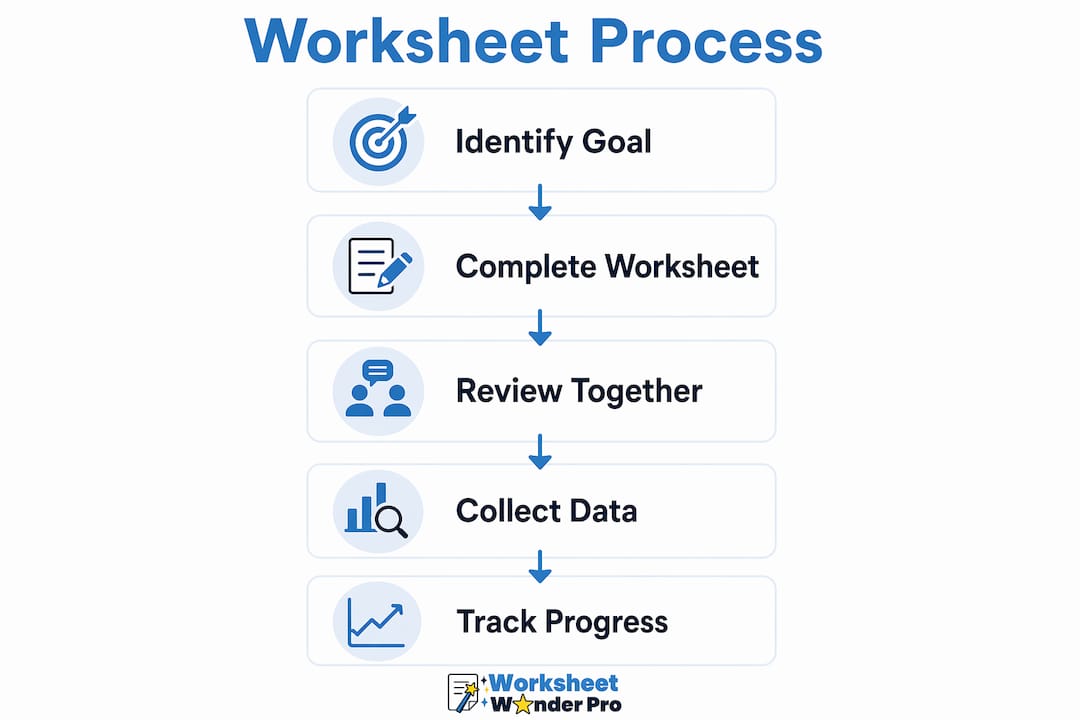
The table below compares two common worksheet types used in behavioral and educational tracking:
| Worksheet type | Primary use | Data produced | Best suited for |
|---|---|---|---|
| ABC chart | Behavioral pattern tracking | Antecedent and consequence patterns | ABA practitioners, special educators |
| Academic progress tracker | Skill drill and mastery monitoring | Completion rates, error patterns, growth trends | Classroom teachers, tutors, parents |
In ABA practice, consistent ABC category definitions on worksheets are non-negotiable. Inconsistent recording produces misleading patterns, which leads to poorly targeted interventions. Standardized forms solve this by removing ambiguity from the recording process.
In academic settings, worksheets that track skill drills and planning tasks give teachers and parents a visible record of where a student is progressing and where gaps remain. This moves support from anecdotal observation to evidence-based decision-making. Worksheetwonderpro's guide on tracking student progress covers how to build worksheets that generate useful data rather than just completed pages.
What are the common pitfalls in using intervention worksheets?
Intervention worksheets fail when they are treated as mechanical tasks rather than integrated tools. Several specific risks undermine their effectiveness:
- Completion as the goal. Completion does not equal engagement. A filled-in worksheet may reflect surface compliance rather than genuine reflection or skill practice.
- Generic or mismatched content. Clinically hollow or academically misaligned worksheets generate surface engagement without depth. The worksheet must match the specific goal and the person's current readiness.
- No feedback loop. Worksheets that do not visibly connect to what happens next lose their purpose. Students and clients stop investing effort when they see no response to their work.
- Overloading with formats. Introducing too many worksheet types at once fragments focus and reduces the quality of engagement with any single tool.
- Privacy gaps in digital use. Digital worksheets require clear consent and data handling protocols. Sensitive behavioral or emotional data collected on digital platforms carries ethical obligations that paper formats do not.
- Retraumatization risk. Worksheets that ask clients to revisit difficult experiences without adequate clinical framing can cause harm. Trauma-informed design and timing matter significantly.
The role of worksheets in learning is well-documented, but that role depends entirely on the quality of the surrounding support structure. A worksheet without a human review process is just paper.
Key takeaways
Intervention worksheets deliver measurable benefits only when embedded in a structured support relationship with consistent review and feedback.
| Point | Details |
|---|---|
| Worksheets extend support | CBT homework and structured practice move skill-building into real-world settings between sessions. |
| Data quality drives decisions | ABC charts require consistent category definitions to produce reliable behavioral patterns for intervention. |
| Completion is not progress | Engagement and clinical value are revealed in review conversations, not in whether the form is filled out. |
| Human support amplifies results | Worksheets with therapeutic or educator follow-up produce significantly better outcomes than minimal-support approaches. |
| Framing determines uptake | Introducing worksheets as collaborative tools rather than assignments preserves autonomy and increases engagement. |
What I've learned from watching worksheets succeed and fail
I have seen intervention worksheets transform a student's self-awareness and I have seen them collect dust in a folder. The difference was never the worksheet itself. It was always the relationship around it.
The practitioners who get the most from these tools treat them as conversation starters. They review what was written, ask about what was hard to answer, and adjust the next tool based on what the data reveals. The ones who struggle tend to assign worksheets and move on, then wonder why engagement drops.
Human support and therapeutic alliance significantly improve effectiveness and reduce dropout rates in worksheet-based interventions. That finding matches what I observe in practice. The worksheet is the prompt. The relationship is the intervention.
Technology has expanded what is possible with digital worksheets, and that is genuinely useful. But it also creates a temptation to automate the follow-up, which is exactly the part that cannot be automated. The most effective approach keeps the human judgment central and uses the worksheet as a data-gathering and reflection tool that feeds back into that judgment.
— Pamela
Build better intervention worksheets with Worksheetwonderpro
Creating worksheets that match your students' or clients' specific goals takes time. Worksheetwonderpro gives educators, therapists, and homeschool families a fast way to build, customize, and organize intervention worksheets aligned with real support needs.
The platform supports structured formats for behavioral tracking, academic skill practice, and therapeutic reflection. You can build tools that match readiness levels, avoid common worksheet design mistakes, and create consistent formats that generate reliable data. Visit Worksheetwonderpro to explore templates and tools built specifically for the people doing this work every day.
FAQ
What is the main purpose of intervention worksheets?
Intervention worksheets provide structured prompts for reflection, skill practice, and behavioral data collection within educational or therapeutic support systems. They are tools that support formulated interventions rather than standalone solutions.
How do ABC worksheets work in behavioral support?
ABC worksheets record the Antecedent, Behavior, and Consequence of specific incidents. Data collected over 5 to 10 days across settings helps practitioners identify behavioral patterns and design targeted intervention plans.
Why does worksheet completion not measure real progress?
A completed worksheet reflects that a form was filled out, not that meaningful reflection or skill practice occurred. Real progress is visible in the review conversation and in how the data informs the next steps of the support plan.
How do you introduce intervention worksheets without resistance?
Introduce worksheets as collaborative tools with a clear purpose tied to the current goal. Complete a section together in-session first, and follow up with a nonjudgmental review rather than a grade or critique.
Are digital intervention worksheets as effective as paper ones?
Digital worksheets with human support produce strong outcomes, with research showing an effect size of g=0.42 for supported digital interventions. They require clear consent and data privacy protocols that paper formats do not.