
Effective worksheet best practices for secondary school start with one principle: worksheets are learning tools, not time-fillers. Research from Edutopia and the UCLA Teaching & Learning Center confirms that worksheets embedded within intentional lesson plans, designed with cognitive load in mind, and paired with structured feedback produce measurably better outcomes than standalone task sheets. Secondary educators and curriculum developers who apply these principles transform ordinary worksheets into active learning experiences. The difference between a worksheet students engage with and one they rush through is almost always design.
1. Worksheet best practices secondary school: chunk tasks into segments
Chunking is the single most effective structural change a teacher can make to a worksheet. Breaking tasks into labeled segments such as Activity A, Activity B, and Activity C prevents cognitive overload and keeps students on task. A worksheet with eight clearly labeled activities outperforms a single block of ten questions because students can track their own progress and feel a sense of completion at each stage. Secondary students typically sustain focused attention for 8 to 10 minutes, so each chunk should match that window.
Pro Tip: Design each chunk to end with a brief pause prompt such as "Check your answer with a partner before moving on." This builds natural pacing into the worksheet without requiring teacher interruption.

2. How to design for working-memory limitations
Working memory is the mental workspace students use to hold and process information during a task. Reducing cognitive load through external thinking space, visible worked examples, and short written instructions directly improves task completion rates in secondary classrooms. Long verbal instructions force students to hold too much in memory at once. Written cues on the worksheet itself free up that mental space for actual thinking.
The table below shows practical design choices mapped to working-memory principles:
| Design choice | Working-memory benefit |
|---|---|
| Leave worked steps visible on the page | Students reference prior steps without re-reading instructions |
| Use numbered sub-steps for multi-part problems | Reduces the need to hold the full sequence in memory |
| Replace paragraph instructions with bullet cues | Lowers verbal processing demand |
| Add a "scratch space" box per section | Externalizes thinking so working memory stays free |
Pro Tip: For math or science worksheets, print a completed example problem in a shaded box at the top of each section. Students use it as a reference without asking for help, which reduces off-task behavior.
3. How to embed formative feedback into worksheet design
Formative feedback works only when students have structured time to act on it. Low-stakes feedback combined with reflection opportunities builds both academic engagement and trust between teacher and student. The most practical way to build this into a worksheet is to add a short revision section after each major task. A two-line prompt such as "What would you change about your answer?" or "Write one thing you are still unsure about" takes under two minutes and creates a feedback loop within the worksheet itself.
- Add a self-check box at the end of each activity segment.
- Include a "next-step prompt" that asks students to identify one area for improvement.
- Design peer-review moments into group tasks by adding a "Partner feedback" line.
- Align every task to a stated learning goal printed at the top of the worksheet.
- Reserve the final section for a brief teacher-comment box, which signals that feedback is expected and valued.
The Wise Feedback model from the UCLA Teaching & Learning Center shows that feedback framed around high expectations and genuine support reduces outcome gaps. Printing a short growth-oriented prompt on the worksheet itself replicates this effect at scale.
4. How to structure worksheets for group work
Group worksheets fail when roles are unclear and accountability is shared in name only. Structured group tasks with defined roles and required collaborative outputs produce deeper engagement than unstructured group assignments. The jigsaw approach assigns each student a distinct content chunk, then requires the group to combine outputs into a shared product such as a poster or annotated diagram. The place mat strategy gives each student a personal section of the worksheet before a central shared section, so individual thinking precedes group synthesis.
- Assign named roles directly on the worksheet: Recorder, Researcher, Presenter, and Checker.
- Link each role to a specific task section so accountability is built into the design.
- Require a shared visual output such as a labeled diagram or summary table that the group completes together.
- Add a brief individual reflection question at the end so each student records their personal contribution.
| Strategy | Best use case |
|---|---|
| Jigsaw | Content-heavy topics where each student masters one section |
| Place mat | Opinion or analysis tasks requiring individual input before group consensus |
| Shared diagram | Science or geography tasks needing collaborative visual synthesis |
5. How differentiated worksheets improve learning outcomes
Differentiated worksheets target the same learning goal through different entry points. Three worksheet versions aligned to visual, auditory, and kinesthetic styles showed a 97.3% validity rating and a 0.51 N-Gain improvement in numeracy scores. That gain is moderate but consistent, meaning differentiation does not require a complete curriculum overhaul to produce results. Parallel worksheets for the same lesson objective keep planning manageable while serving a wider range of learners.
- Visual learners: Include labeled diagrams, color-coded steps, and graphic organizers.
- Auditory learners: Add discussion prompts and sentence starters that mirror spoken reasoning.
- Kinesthetic learners: Use cut-and-sort tasks, matching activities, or hands-on data collection sections.
Curriculum developers can create parallel worksheet versions from a single master template by swapping the task format while keeping the learning objective identical. This approach scales without multiplying planning time.
6. Embedding mini-lessons before worksheet tasks
A worksheet handed out cold rarely produces the thinking it was designed to elicit. Adding a mini-lesson before worksheet tasks and including prompts that increase rigor yield measurable gains in student thinking. A five-minute modeling session before students begin gives them the schema to interpret instructions correctly. The worksheet then functions as guided practice rather than a test of whether students can decode the task.
Practical design choices that support this include printing a "Before you start" box at the top of the worksheet with one or two activating questions. These questions connect the task to prior knowledge and reduce the time students spend confused at the start. Teachers can also add a "Rigor prompt" at the end of each section, such as "Explain why, not just what," to push thinking beyond surface-level responses. This small addition costs nothing in design time and significantly raises the cognitive demand of the worksheet.
Key takeaways
Effective worksheet design for secondary school requires chunking, cognitive load management, embedded feedback, and structured collaboration working together.
| Point | Details |
|---|---|
| Chunk tasks into segments | Label activities A, B, C to match 8 to 10 minute attention spans and reduce off-task behavior. |
| Design for working memory | Use visible worked examples, short written cues, and scratch space to free up mental processing. |
| Embed formative feedback | Add self-check boxes and next-step prompts so feedback happens within the worksheet, not after. |
| Structure group roles | Assign named roles and require shared outputs to create real accountability in collaborative tasks. |
| Differentiate by modality | Create parallel visual, auditory, and kinesthetic versions of the same worksheet to improve learning gains. |
What I have learned about worksheet design in secondary classrooms
The most common mistake I see is treating the worksheet as the lesson. A worksheet is practice material. It works when the teacher has already modeled the thinking, set the context, and defined the goal. When a worksheet arrives without that foundation, students fill in blanks without understanding why.
The second pattern worth noting is that feedback sections get cut first when teachers are short on time. That is exactly backward. A worksheet without a feedback loop is a one-way transaction. Students complete it, hand it in, and move on. Building even a two-line reflection prompt into the design costs nothing and changes the entire learning cycle. The role of worksheets in classroom learning is to support thinking, not replace it. Teachers who keep that distinction clear consistently get better results from the same material.
— Pamela
How Worksheetwonderpro supports secondary educators
Worksheetwonderpro gives secondary teachers and curriculum developers the tools to apply these design principles without starting from scratch every time.
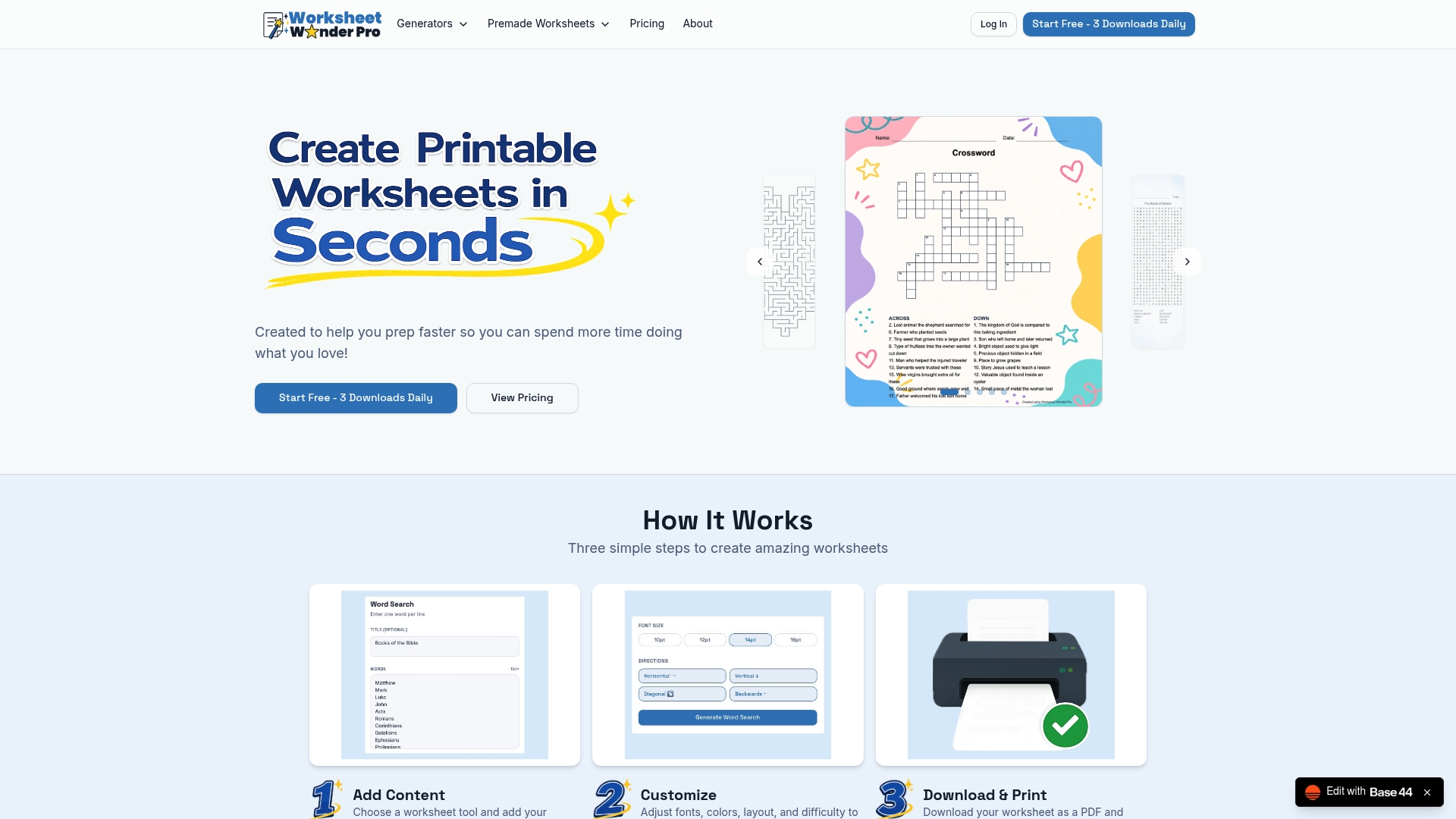
The platform supports custom worksheet creation with built-in differentiation options, feedback sections, and chunked task layouts. Free templates on the free resources page are ready to adapt for any subject or year group. Teachers who need advanced tracking and collaborative design features can explore the full toolkit at Worksheetwonderpro. The goal is to make research-backed worksheet design fast and repeatable for every classroom.
FAQ
What makes a worksheet effective for secondary students?
Effective worksheets for secondary students are chunked into labeled segments, aligned to a clear learning goal, and include at least one built-in feedback or reflection prompt. Design choices that reduce working-memory load, such as visible worked examples and short written instructions, consistently improve task completion.
How many questions should a secondary school worksheet have per section?
Each section should contain three to five questions to match the 8 to 10 minute attention span typical of secondary learners. Chunking into 3-question segments with visible worked examples is linked to higher student success rates than longer unbroken question blocks.
How do you differentiate worksheets without doubling your planning time?
Create one master worksheet and produce parallel versions by changing the task format while keeping the learning objective identical. Differentiated contextual worksheets aligned to visual, auditory, and kinesthetic styles showed a 0.51 N-Gain improvement in numeracy without requiring separate curriculum planning.
How should group work be structured on a worksheet?
Assign named roles such as Recorder, Researcher, and Presenter directly on the worksheet and link each role to a specific task section. Requiring a shared visual output, such as a diagram or summary table, creates accountability and ensures all students contribute to the final product.
When should feedback be given on worksheet tasks?
Feedback is most effective when students have structured time to act on it within the same learning cycle. The UCLA Teaching & Learning Center recommends building course time for students to process and apply feedback rather than returning marked work without a follow-up activity.