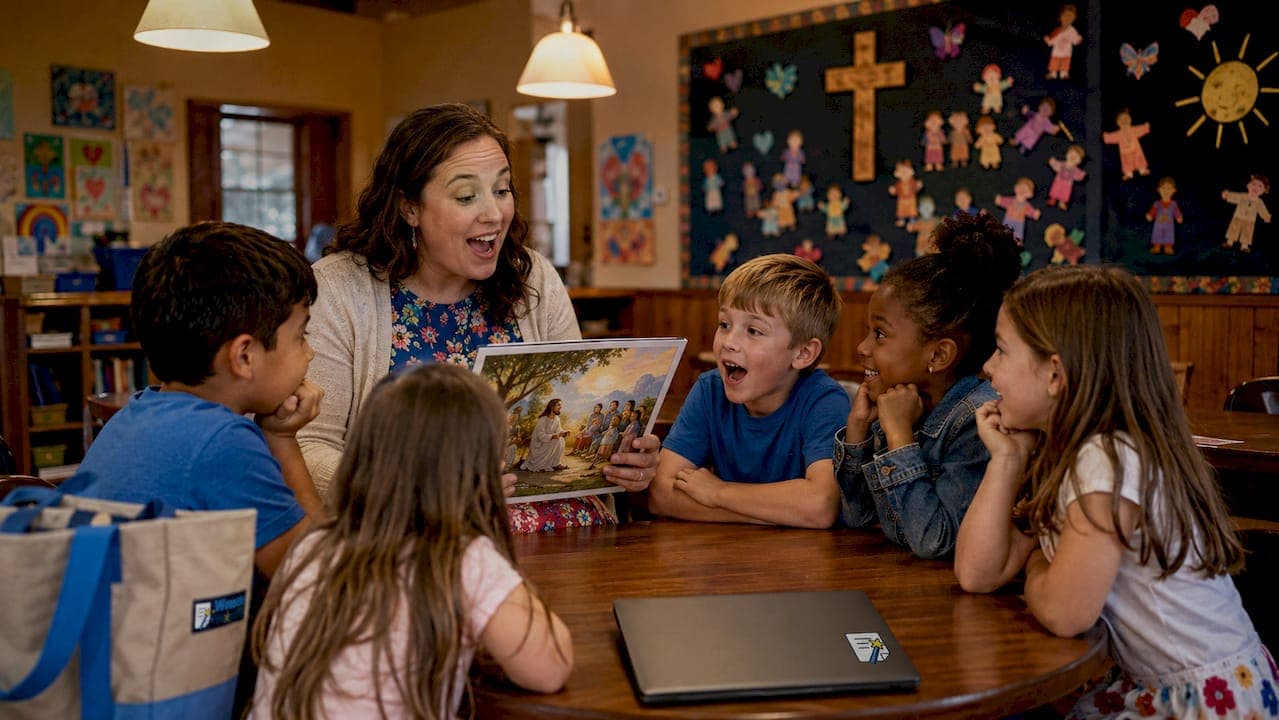
A Sunday school lesson is a structured Bible study session designed to teach children and youth biblical truths in an age-appropriate, memorable way. These lessons form the backbone of children's ministry in churches and serve equally well in homeschool settings. Structured curricula like Lifeway's children's programs and the free 325-lesson series from DIY Homeschooler give teachers a complete framework covering scripture reading, age-specific activities, and memory verses. The goal is not just knowledge transfer. It is faith formation.
What makes a Sunday school lesson effective?
An effective Sunday school lesson centers on a single, clear Bible passage or theme. Trying to cover too much in one session dilutes the message. Picking one story, one truth, or one character and building the entire lesson around it gives children something concrete to hold onto.
Age-appropriate activities are the delivery mechanism for that truth. The right activity depends on the age group:
- Preschoolers respond to sensory play, movement, and repetition. Simple crafts and songs reinforce the lesson without overwhelming them.
- Elementary children (ages 6 to 12) benefit from puzzles, drawing activities, and short discussion questions that ask them to apply what they heard.
- Youth (ages 13 and up) engage most when lessons connect to real-life decisions and include open discussion rather than lecture.
Memory verses are a proven tool for biblical literacy. Memory verses and crafts increase retention and give children a scriptural anchor they carry beyond Sunday morning. Pairing a verse with a physical activity or visual aid makes it stick faster than repetition alone.
Storytelling and discussion round out the lesson. Children learn more when they talk about what they heard, not just listen to it. Asking "What would you have done?" or "Where do you see this in your life?" shifts the lesson from passive to participatory.

Pro Tip: Balance every 10 minutes of teaching content with at least 5 minutes of interactive activity. This ratio keeps attention high and retention higher.
How do Sunday school curricula compare?
Not all Sunday school curriculum types serve every setting equally. Three main styles dominate the market, and each has a distinct structure.
Chronological curricula move through the Bible in order, from Genesis to Revelation. Foundations Preschool Bible Curriculum uses this approach, keeping young learners anchored in the Bible's narrative arc while centering Jesus as the hero of every story, not just the New Testament.
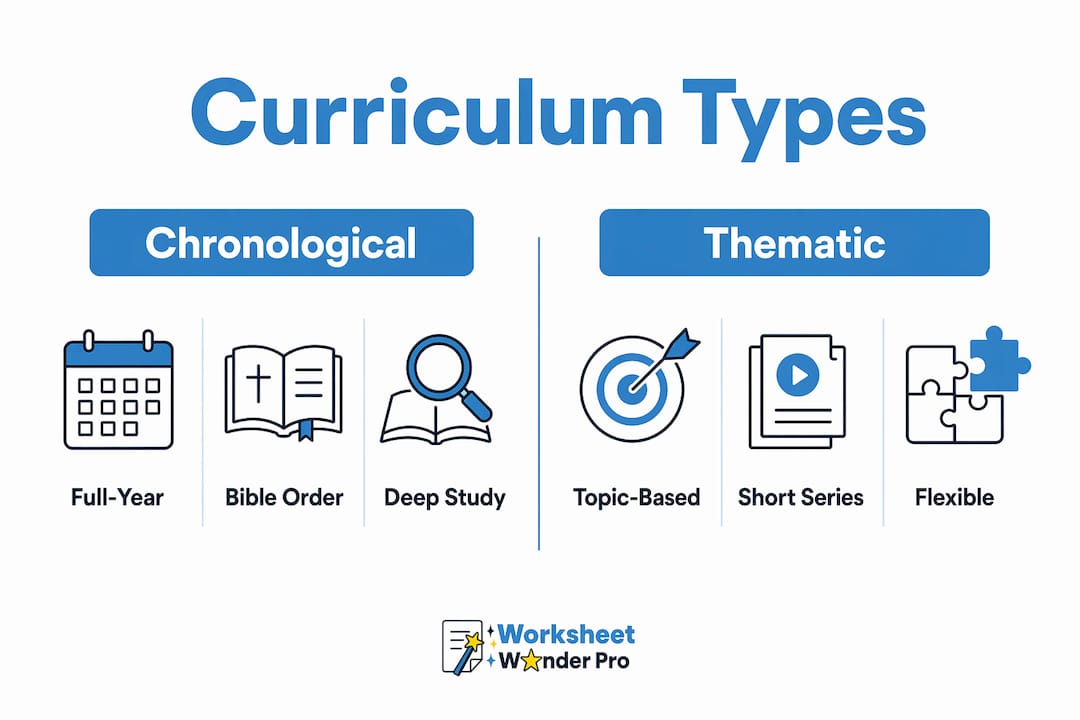
Thematic curricula organize lessons around topics like prayer, forgiveness, or missions. These work well for short series or seasonal teaching. A Pentecost-focused unit, for example, gives a church a focused four-week block without requiring year-round commitment to a single program.
Unified scope and sequence curricula teach all age groups the same passage on the same Sunday. The One Story Curriculum from Raise Up Faith uses this model. Unified teaching across ages creates consistent learning that carries into family conversations at home and simplifies planning for teachers who manage multiple classes.
| Curriculum type | Best for | Prep time | Age range |
|---|---|---|---|
| Chronological | Full-year church programs | Moderate | All ages |
| Thematic | Short series or seasonal use | Low to moderate | All ages |
| Unified scope and sequence | Multi-age churches and families | Low | All ages |
| Free downloadable bundles | Homeschool and budget settings | Low | Varies |
Free resources are genuinely viable. The 52-week curriculum bundle from Sunday School Store organizes a full year by monthly themes including missions, history, and theology. This eliminates last-minute scrambling and keeps teaching consistent across the calendar year.
Pro Tip: Volunteer teachers benefit most from no-prep or low-prep curricula. Prioritize programs that use common household items and require no special supplies.
How to engage different age groups in Bible lessons
Teaching a three-year-old and a thirteen-year-old requires completely different approaches. Developmental stage determines which methods work and which fall flat.
For preschoolers, the body is the primary learning tool. Movement-based learning, sensory play, and repetitive songs are not just fun. They are how young children encode information. A lesson on Noah's Ark lands better when children act out the animals boarding the boat than when they sit and listen to the story read aloud.
For elementary children ages 8 to 12, 90 puzzles and 40 Bible passages per volume in programs like Bible Investigators: Creation develop observation, interpretation, and application skills simultaneously. This age group is ready to ask "why" and "how," so lessons that include structured questions produce deeper engagement than activities alone.
For youth, the most effective method is real-life application. A lesson on forgiveness hits differently when students are asked to name a situation where they struggled to forgive someone. Critical thinking questions, case studies drawn from current events, and honest discussion about doubt all work well for this group.
Across all ages, blended learning modalities increase engagement and retention. Combining object lessons, storytelling, crafts, and interactive games in a single session addresses multiple learning styles at once. A lesson on Jesus as the Good Shepherd, for example, can include a short story, a sheep-themed craft, a memory verse game, and a discussion question. Each element reinforces the same truth from a different angle.
- Start with a hook. Open with a question, object, or short story that connects to the lesson theme.
- Deliver the Bible content. Read the passage together or tell the story with expression and detail.
- Apply it. Use an activity, discussion, or game that asks children to connect the truth to their own lives.
- Close with the memory verse. Repeat it together at least three times using different methods.
How to prepare lessons efficiently with limited time
Most Sunday school teachers are volunteers. Time is the real constraint, not motivation. Practical preparation strategies make the difference between a lesson that happens and one that does not.
- Use print-and-teach lesson plans that require no special materials. No-prep lessons using household items are specifically designed for volunteer teachers who cannot spend hours preparing each week.
- Plan in thematic units. Preparing four lessons on the same theme at once takes less time than preparing four separate standalone lessons. You reuse the same background knowledge and often the same materials.
- Download free lesson bundles in advance. Having six to eight weeks of lessons ready removes the weekly pressure entirely.
- Keep a simple supply kit. A box with crayons, scissors, glue sticks, and blank paper covers the craft component of most elementary lessons without any shopping.
- Build in flexibility. Children ask unexpected questions. The best teachers treat those moments as the lesson, not as interruptions.
Pro Tip: Ask children questions throughout the lesson rather than saving discussion for the end. Questions mid-lesson keep attention focused and give you real-time feedback on what they understand.
Key takeaways
Effective Sunday school lessons combine a clear Bible focus, age-appropriate activities, and gospel-centered teaching to build lasting biblical literacy in children and youth.
| Point | Details |
|---|---|
| Clear Bible focus | Build each lesson around one passage or truth to avoid diluting the message. |
| Age-appropriate methods | Use movement for preschoolers, puzzles for elementary, and discussion for youth. |
| Unified curricula | Teaching all ages the same passage simplifies planning and sparks family conversation. |
| Low-prep resources | No-prep, print-and-teach plans reduce volunteer burden without reducing lesson quality. |
| Memory verses | Pairing verses with physical activities increases retention beyond Sunday morning. |
What I have learned from years of watching lessons land and fall flat
The lessons that children remember years later are rarely the ones with the most elaborate crafts or the longest scripture reading. They are the ones where a teacher asked a real question and actually waited for the answer.
Gospel-centered storytelling is the single most consistent factor in lessons that stick. When children see Jesus as the central figure of every Bible story, not just the Christmas and Easter ones, the whole Bible starts to make sense as one connected story. That shift changes how they read scripture on their own.
The challenge most teachers face is not lack of knowledge. It is the pressure to perform. A lesson does not need to be perfect to be meaningful. Children are remarkably forgiving of stumbles. What they notice is whether the teacher believes what they are teaching. Authenticity carries more weight than polish.
Training children in biblical disciplines like reading scripture and prayer builds a personal relationship with God that outlasts any single lesson. That is the real goal. The worksheet, the craft, the memory verse game. They are all tools toward something much larger.
Sunday school is relational ministry first and education second. The teacher who knows a child's name, remembers their story, and shows up consistently week after week is already doing the most important work before the lesson even begins.
— Pamela
Ready-to-use Sunday school resources from Worksheetwonderpro
Teachers and homeschool families looking for print-and-teach Bible lesson materials can find a full library at Worksheetwonderpro. The platform offers free and premium resources suited to preschool through youth, including activity sheets, puzzle templates, and structured lesson plans that require minimal preparation time.
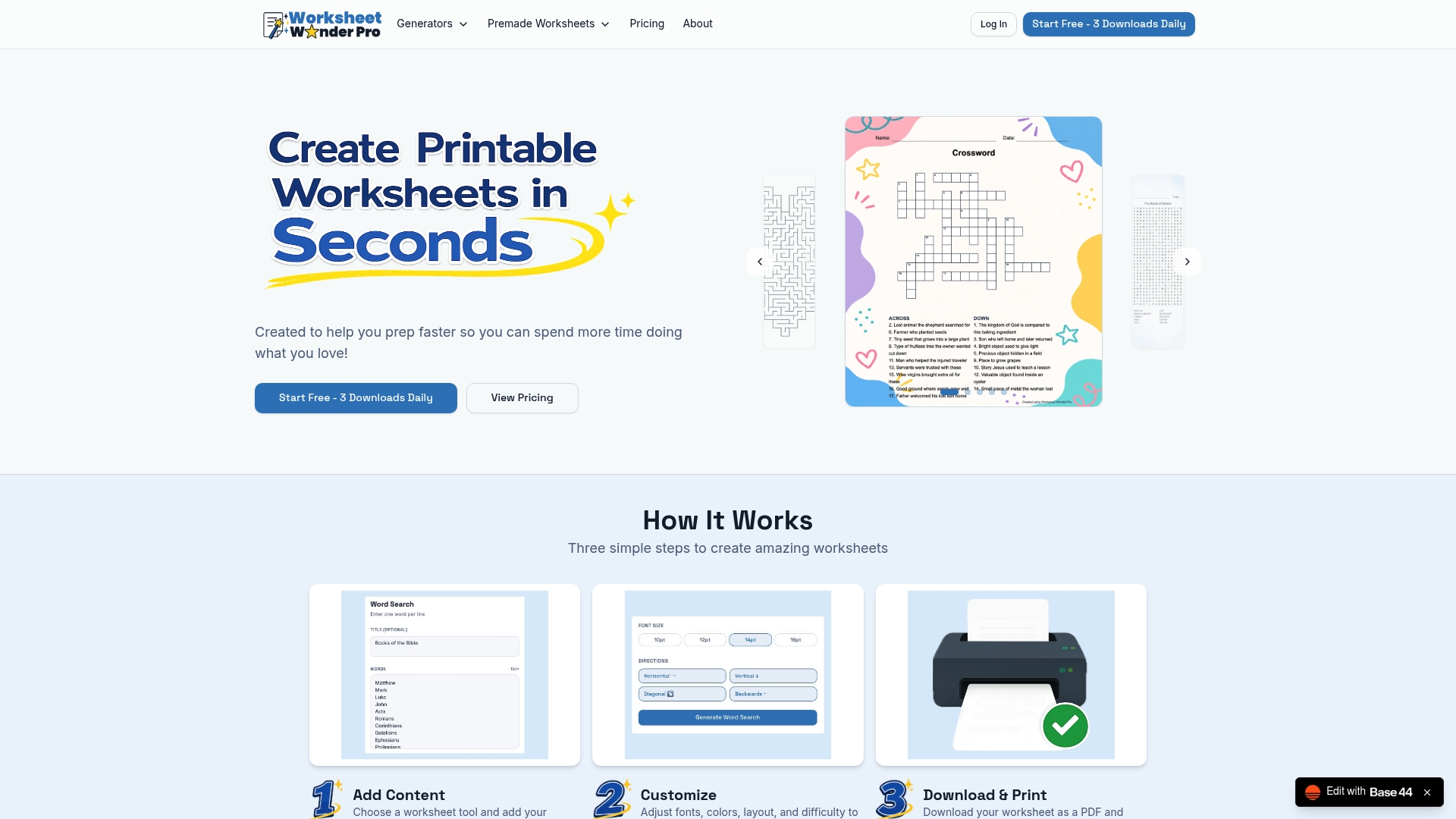
Worksheetwonderpro also provides free downloadable resources including Bible study guides, printable worksheets, and activity packs designed specifically for Sunday school teachers and homeschool families. Every resource is built to save time and keep children engaged with the material.
FAQ
What is a Sunday school lesson?
A Sunday school lesson is a structured Bible study session designed for children or youth, typically including a scripture focus, age-appropriate activities, and a memory verse. It is used in both church ministry and homeschool settings to teach biblical truths.
How long should a Sunday school lesson be?
Most Sunday school lessons run between 45 and 60 minutes for elementary-aged children. Preschool sessions work best at 30 to 45 minutes, while youth lessons can extend to 60 to 90 minutes with discussion time included.
What is the best free Sunday school curriculum?
The free 325-lesson Bible curriculum from DIY Homeschooler covers both Old and New Testaments and includes scripture reading, activities by age group, and memory verses. It is one of the most complete free options available for teachers and homeschoolers.
How do I keep kids engaged during a Bible lesson?
Blended learning methods combining storytelling, crafts, object lessons, and interactive games increase engagement across all age groups. Asking questions throughout the lesson rather than only at the end keeps children actively involved.
What is a unified Sunday school curriculum?
A unified curriculum teaches all age groups the same Bible passage on the same Sunday. The One Story Curriculum from Raise Up Faith uses this model to support family discussion at home and reduce planning complexity for teachers.