
A weather tracking worksheet is a structured recording tool that helps children observe, document, and analyze daily weather conditions in a systematic, educational format. These worksheets are used in classrooms, homeschool settings, and home environments to build foundational science skills through direct observation. Common elements include temperature, precipitation, wind speed, sky conditions, and cloud types. Resources from NOAA and printable sets like those from JessBeeCreates.com provide ready-made formats that educators and parents can use immediately. The core purpose is to turn everyday weather into a repeatable, data-driven learning activity.
What is a weather tracking worksheet and what types exist?
Weather tracking worksheets fall into four main formats, each suited to different teaching goals. Understanding which format fits your learning objectives saves time and produces better results.
Daily and weekly worksheets focus on short-term weather variation. Weekly logs are ideal for "what changed?" conversations, helping children notice how temperature drops before rain or how wind shifts with cloud cover. These formats work well for younger learners who benefit from immediate, visible feedback.
Monthly and yearly worksheets support broader pattern recognition. Monthly and yearly tracking pages allow children to record temperature, precipitation, wind speed, and sky conditions across longer periods, making seasonal shifts visible and discussable. This format suits older students working on climate-style thinking.
| Worksheet type | Best use | Key features |
|---|---|---|
| Daily log | Immediate observation practice | Single-day fields, icon boxes, temperature space |
| Weekly log | Short-term pattern discussions | 7-day grid, comparison columns |
| Monthly log | Seasonal trend identification | Calendar-style layout, summary row |
| Yearly log | Climate-level data collection | Month-by-month overview, graphing space |
| Weather wheel | Concept instruction | Rotating visual, cloud and wind categories |

NOAA offers free downloadable materials including hurricane charts and weather wheels that pair directly with observation journals. These tools add concept instruction alongside raw data recording, which plain grids cannot do alone.
Pro Tip: Start with a weekly format for new learners. It provides enough data for a meaningful discussion without overwhelming a child who is just learning to observe.
What are the educational benefits of weather worksheets for kids?
Weather tracking worksheets develop three core skills that support broader STEM learning: observation, data recording, and pattern recognition. Structured worksheets with observation prompts encourage scientific inquiry and practical learning of meteorological concepts. Each skill builds directly on the previous one, creating a natural learning progression.
The specific benefits include:
- Observation skills. Children learn to look at the sky with purpose, noting cloud types, wind direction, and precipitation rather than simply registering "sunny" or "rainy."
- Data recording habits. Filling in a weather tracking sheet daily teaches consistency and attention to detail, both of which transfer to other science subjects.
- Pattern recognition. Reviewing a month of data helps children spot recurring conditions, such as afternoon thunderstorms in summer or frost following clear nights.
- Critical thinking. Comparing one week's data to another prompts questions like "Why was last week warmer?" This is inquiry-based learning in its simplest form.
- Meteorology vocabulary. Worksheets with labeled fields for terms like "cumulus," "barometric pressure," and "precipitation type" build subject-specific language naturally.
"NOAA emphasizes that weather wheels and cloud charts provide direct concept instruction alongside tracking activities, making lessons more interactive and concept-focused." — NOAA Weather Printables
Pairing a weather data analysis worksheet with NOAA's cloud spotting guides or weather wheels gives children both the recording structure and the reference material to understand what they are recording. The combination produces deeper learning than either tool delivers alone.
How to create and customize a weather tracking worksheet
Creating a worksheet that fits your learner takes five clear steps. The goal is a format that matches the child's age, the tracking period, and the specific concepts you want to teach.
- Choose the tracking period. Select daily, weekly, or monthly based on your learning objective. Use weekly logs for short-term variation discussions and monthly or yearly logs for climate observations and longer planning cycles.
- Select your data types. Include both quantitative fields (temperature in °F, rainfall in inches) and qualitative fields (sky description, cloud type, "feels like" notes). Recording observations twice daily covering temperature, pressure, humidity, wind speed, and sky descriptions builds meaningful pattern data over time.
- Add visual elements for younger learners. Children drawing weather icons such as sun, clouds, or raindrops on daily logs improve awareness and interactive engagement. Icon boxes next to data fields work well for grades K through 2.
- Integrate with related activities. Connect the worksheet to a weather journal, a gardening log, or a science notebook. This gives the data context and shows children that weather affects real-world outcomes.
- Plan for data review. Build a weekly or monthly review session into your schedule. This is where the learning deepens. Without review, a completed worksheet is just a record. With review, it becomes a discussion tool.
You can also use digital spreadsheet templates or tools like Google Sheets as alternatives to paper formats. These work well for older students learning basic data management alongside weather science. For designing effective tracking worksheets, clear field labels and consistent layout matter more than visual complexity.
Pro Tip: Consistency matters more than completeness. A worksheet filled in five days out of seven for a full month produces more useful data than a perfectly filled sheet used for two weeks.
How do you analyze weather data from a tracking worksheet?
Analyzing recorded weather data turns a weather tracking sheet into a genuine science activity. The process starts with reviewing individual variables and then looking for relationships between them.
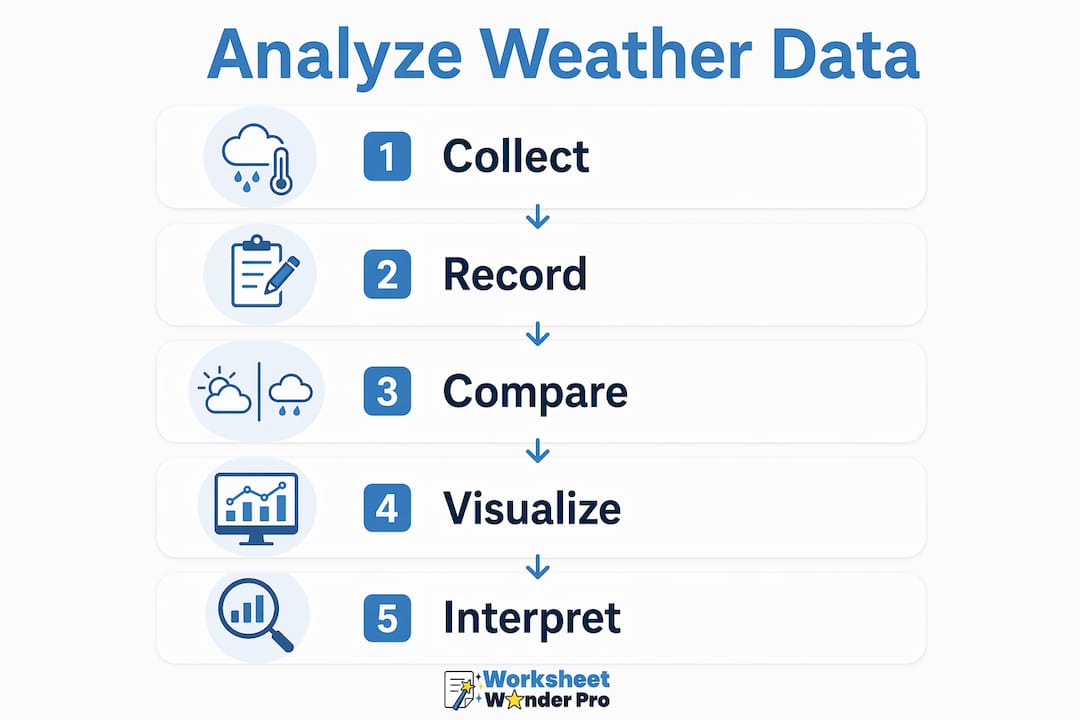
Creating charts and plots from weather logs supports data visualization skills and scientific inquiry. A simple bar chart of daily high temperatures across a month makes warming and cooling trends immediately visible to children who cannot yet read a data table fluently.
Specific analysis activities include:
- Temperature trend lines. Plot daily highs and lows on a line graph. Ask children to identify the warmest and coldest weeks and propose reasons for the difference.
- Precipitation counts. Tally rainy days per week and compare across months. This introduces the concept of seasonal rainfall patterns.
- Sky condition frequency. Count how many days were sunny, cloudy, or overcast. Pair this with temperature data to show the relationship between cloud cover and temperature.
- Correlation exercises. Show children that a drop in recorded pressure often precedes rain. This introduces basic predictive reasoning without requiring advanced math.
A sample data review table helps structure the discussion:
| Variable | Week 1 | Week 2 | Week 3 | Week 4 |
|---|---|---|---|---|
| Avg. high temp (°F) | 68 | 72 | 65 | 60 |
| Rainy days | 1 | 0 | 3 | 4 |
| Cloudy days | 2 | 1 | 4 | 5 |
This kind of table makes the relationship between cloud cover, rain, and temperature visible at a glance. Children can draw their own conclusions before you explain the science, which is the core of inquiry-based learning.
Key takeaways
A weather tracking worksheet is most effective when it combines consistent daily observation with structured data review and age-appropriate visual formats.
| Point | Details |
|---|---|
| Definition and purpose | A weather tracking worksheet records daily conditions to build observation and data skills in children. |
| Format selection | Match the worksheet type (daily, weekly, monthly) to your specific learning objective and the child's age. |
| Educational value | Worksheets develop observation, pattern recognition, and meteorology vocabulary through hands-on practice. |
| Customization tips | Include both quantitative and qualitative fields, and add icon boxes for younger learners. |
| Data analysis | Graphing and comparing recorded data turns raw observations into scientific inquiry activities. |
Why weather tracking worksheets are worth the effort
I have used weather tracking worksheets with students across a wide age range, and the single biggest mistake I see is treating the worksheet as the end product. Teachers hand it out, children fill it in, and the paper goes into a folder. The learning stops there.
The real value shows up during the review session. When a child looks at four weeks of data and says, "It rained every time the sky was gray for two days in a row," that is genuine scientific reasoning. No textbook produces that moment. The worksheet does, but only if you build in the time to analyze what was recorded.
Consistency is the other challenge. Weather tracking works as a project-based learning activity only when the data set is long enough to show patterns. Two weeks of data is interesting. Six weeks of data is instructive. I recommend committing to a full calendar month before drawing any conclusions with students.
For educators who are new to this, start with a simple weekly format from NOAA or a free printable set. Do not design your own worksheet until you have used a ready-made one and identified what your specific learners need that the template does not provide. That gap is where customization becomes worth the time.
— Pamela
Start building weather worksheets with Worksheetwonderpro
Worksheetwonderpro gives teachers, homeschool families, and caregivers the tools to create and download weather tracking worksheets without starting from scratch.

The platform offers customizable worksheet formats suited to daily, weekly, and monthly weather observation activities. Educators can adjust fields, add icon sections, and tailor layouts to match specific grade levels or curriculum goals. Beyond weather, Worksheetwonderpro covers science, planning, and cross-subject resources in one place. Free downloads are available through the free resources page for educators who want to test formats before customizing. It is a practical starting point for any weather tracking project.
FAQ
What is a weather tracking worksheet used for?
A weather tracking worksheet is used to record daily weather conditions including temperature, precipitation, wind, and sky conditions. It supports observation skills, pattern recognition, and basic meteorology learning in children.
What data should a weather tracking sheet include?
A weather tracking sheet should include temperature, precipitation type and amount, wind speed, sky conditions, and cloud descriptions. Recording both quantitative and qualitative data twice daily produces the most useful pattern data.
How does daily weather tracking help children learn science?
Daily weather tracking builds observation habits, data recording skills, and the ability to spot patterns over time. These are foundational STEM skills that transfer directly to other science subjects.
What NOAA resources pair well with weather worksheets?
NOAA offers free downloadable weather wheels, cloud spotting guides, and hurricane charts that provide direct concept instruction alongside tracking activities. These materials are available through the NOAA education printables collection.
How long should a weather tracking project run?
A weather tracking project should run for at least one full month to generate enough data for meaningful pattern analysis. Shorter periods produce observations but not the trends needed for scientific discussion.