
A biography worksheet is one of those tools that students and teachers often misunderstand. Many assume it is just a fact sheet, a place to dump names and dates before writing a paper. That framing undersells what it actually does. A biography worksheet is a structured educational template designed to help students collect, organize, and sequence key facts about a person's life. Used well, it turns scattered research into a clear writing plan. This guide explains what a biography worksheet is, how to use one, and why it matters for students, educators, and parents.
Table of Contents
- Key takeaways
- What is a biography worksheet, exactly?
- How to do a biography worksheet step by step
- Why biography worksheets matter for learning
- Biography worksheet examples and templates
- My take on using biography worksheets well
- Create biography worksheets with Worksheetwonderpro
- FAQ
Key takeaways
| Point | Details |
|---|---|
| Definition is specific | A biography worksheet is a structured template for organizing life facts, not just a fact dump. |
| Core sections are standard | Most worksheets cover personal info, early life, achievements, impact, and legacy. |
| Four-step process works | Choose a subject, research, fill in the worksheet, then draft the final biography. |
| Worksheets scaffold learning | They break research into sections so students avoid feeling overwhelmed by large projects. |
| Templates can be customized | Printable and digital formats exist for different grade levels and assignment types. |
What is a biography worksheet, exactly?
A biography worksheet is a structured template that guides students through collecting and organizing facts about a real person. It is typically used for students in grades 2 through 12. The worksheet sits between raw research and finished writing. It gives students a place to sort what they find before they try to write anything.
The sections found on most biography worksheets follow a logical order. They move from basic facts toward deeper reflection on a person's significance.
Common sections include:
- Personal information: Full name, birth date, birthplace, and nationality
- Early life: Family background, childhood experiences, and education
- Career highlights: Major accomplishments, roles held, and key contributions
- Challenges and turning points: Obstacles the subject faced and how they responded
- Legacy and impact: How the person influenced their field or the world
These common elements guide student research by showing them exactly what to look for. Without this structure, students often collect too many unrelated facts and struggle to write a coherent biography.
What a biography worksheet looks like in practice
Here is a quick comparison of what an unstructured approach versus a worksheet-guided approach produces:
| Without a worksheet | With a biography worksheet |
|---|---|
| Random notes from multiple sources | Facts sorted by life stage and theme |
| Repeated or irrelevant information | Targeted research tied to specific fields |
| Difficulty starting the draft | Clear outline ready for writing |
| Missed key details | Prompts remind students what to include |
The difference is significant. A worksheet does not just organize notes. It teaches students what to include in a biography in the first place.

How to do a biography worksheet step by step
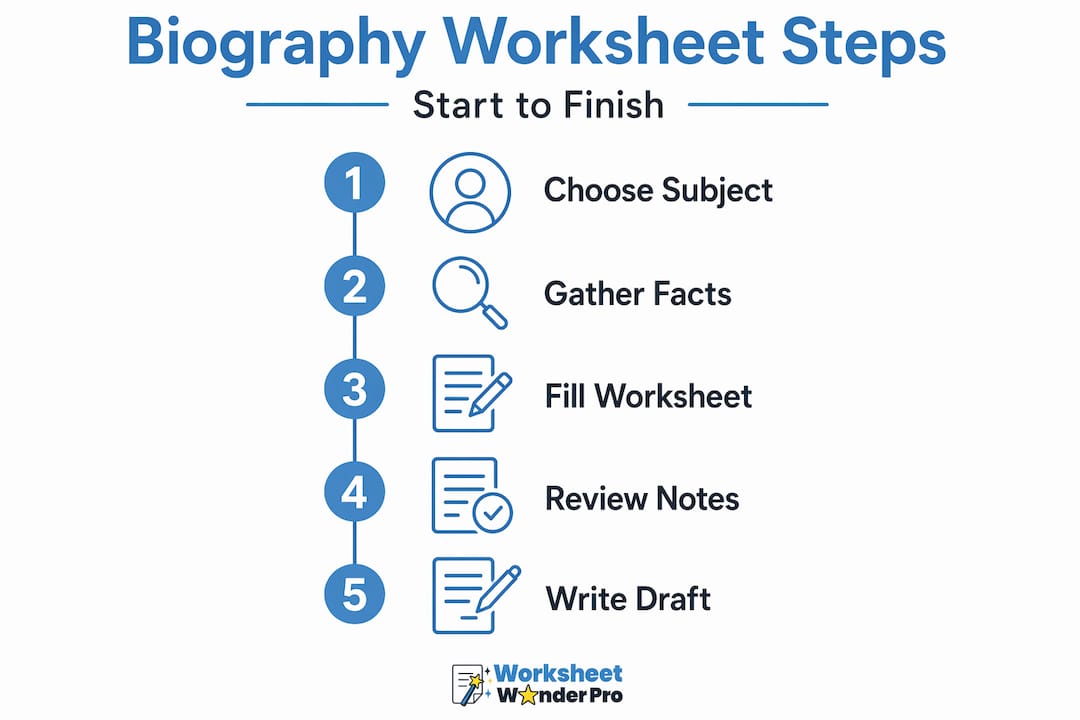
Worksheets are often one to two pages and come in printable or editable digital formats. Either way, the process for using one follows four clear steps.
-
Choose a subject. The student or teacher selects a person to research. This could be a historical figure, a scientist, an author, or a community leader. The subject should match the assignment goals and the student's reading level.
-
Research the subject. Students gather information from books, credible websites, and encyclopedias. At this stage, the worksheet fields act as a checklist. Students know they need to find a birthdate, a key accomplishment, and information about the subject's legacy before they are done researching.
-
Fill in the worksheet sections. Students record findings directly in the worksheet. Each section gets its own notes. This keeps research organized by theme rather than by source, which makes writing much easier later.
-
Draft the biography. With the worksheet complete, students have a ready-made outline. Each section of the worksheet corresponds to a paragraph or section in the final biography or presentation.
Teachers and parents can support this process by checking the worksheet at each step. Reviewing completed research before students start drafting catches gaps early.
Pro Tip: Have students highlight or color-code their notes by source type before filling in the worksheet. Verified encyclopedia facts, personal anecdotes, and online content each get a different color. This makes source evaluation a built-in part of the process, not an afterthought.
Why biography worksheets matter for learning
Biography worksheets are scaffolding tools. That word gets used loosely in education, but here it means something specific. The worksheet breaks a large, complex task into smaller, sequential sections. Students who might freeze in front of a blank page can fill in one field at a time.
Biography worksheets prevent students from feeling overwhelmed by organizing research into thematic sections, encouraging steady progress rather than last-minute cramming.
This matters because biography projects tend to be long-form assignments. Without a clear process, many students put everything off and produce weak work under pressure. Process-based grading of completed worksheet stages addresses this directly. When teachers grade the worksheet as part of the assignment, students stay on track.
The deeper benefit is research literacy. A well-designed worksheet does more than organize facts. It pushes students to:
- Evaluate whether a source is credible before copying information
- Synthesize facts from multiple sources into their own words
- Identify gaps in their research before the writing stage begins
- Distinguish between verified facts and questionable or AI-generated content
Pro Tip: Teach students to write notes in their own words inside the worksheet fields rather than copying quotes. This one habit significantly reduces the likelihood of unintentional plagiarism in the final biography.
These skills transfer well beyond the biography project. Students who learn to evaluate sources and synthesize information in a low-stakes structured context carry those habits into more demanding assignments.
Biography worksheet examples and templates
Not all biography worksheets look the same. The right format depends on the student's age, the subject of the biography, and the complexity of the assignment. Understanding biography worksheet examples helps teachers and parents choose or build the right tool.
Common template types include:
- General biography worksheet: Covers all standard sections and works for most subjects and grade levels
- Famous people worksheet: Focuses on public impact, historical context, and cultural significance
- Self-biography worksheet: Guides students through writing about their own lives, useful for personal writing activities
- Historical figure worksheet: Adds fields for time period, political context, and historical relevance
Printable templates work well for classroom settings where students write by hand. Digital interactive formats work better for remote learning or technology-integrated classrooms. Some digital versions include embedded links, drop-down fields, or auto-formatting that reduces setup time.
Customization is straightforward. For younger students in grades 2 through 4, worksheets typically use fewer fields and simpler language. For high school biography project ideas, templates can include sections on source evaluation, counterarguments to the subject's legacy, and primary source analysis.
Teachers looking for ready-made options can find both free and premium biography worksheet templates designed for different grade levels and project types. Premium versions often include editable fields and differentiated versions for varied reading levels.
My take on using biography worksheets well
I've watched students treat biography worksheets like a box-checking exercise. They fill in names and dates as fast as possible and call it done. The worksheet becomes busywork, not a learning tool. That happens when the worksheet is handed out without any explanation of why each section matters.
In my experience, the shift happens when students understand that the worksheet is their outline. Every field they fill in is a paragraph they will not have to invent later. Once students see the connection between a completed worksheet and an easier writing process, their engagement changes.
I've also found that biography writing activities work best when the research stage is treated as an ongoing conversation. Teachers and parents who check in at each step, not just at the final draft, catch misunderstandings early. A student who spends two days researching the wrong person, or pulling facts from an unreliable site, loses significant time that a quick mid-point check would have saved.
The best biography worksheets do not just tell students what to find. They teach students how to think about a person's life. That distinction is worth building into every assignment.
— Pamela
Create biography worksheets with Worksheetwonderpro
Worksheetwonderpro gives teachers, homeschool families, and ministry leaders tools to build and customize biography worksheets without starting from scratch.
The premade worksheet library includes biography templates designed for different grade levels and subject types. Printable and digital formats are both available. Educators can edit fields, adjust complexity, and tailor any template to fit their specific assignment requirements. For those who want to build a custom layout, the worksheet creation tool makes that fast. Pricing details and subscription options are available for individuals, classrooms, and schools.
FAQ
What is a biography worksheet used for?
A biography worksheet is used to help students organize research about a person's life before writing a biography. It provides structured sections for facts like birthdate, achievements, and legacy.
What should a biography worksheet include?
A biography worksheet typically includes fields for personal information, early life, career highlights, major challenges, and the subject's lasting impact or legacy.
How do you complete a biography worksheet?
Students choose a subject, research key facts, fill in each section of the worksheet with organized notes, and then use the completed worksheet as an outline to draft the final biography.
What grade levels use biography worksheets?
Biography worksheets are commonly used for students in grades 2 through 12, with simpler formats for younger students and more detailed templates for high school assignments.
Are biography worksheets available as printable templates?
Yes. Biography worksheets come in both printable and digital formats, allowing teachers and parents to choose the version that fits their classroom or home learning setup.