
Most teachers and homeschool parents assume that if a student completes a grammar worksheet and gets most of the answers right, learning has happened. That assumption is surprisingly fragile. Constance Weaver's observation points to a persistent problem: students may succeed on worksheets but struggle to apply that knowledge in their own writing. This article breaks down why that gap exists, what research says about fixing it, and how you can build worksheet routines that genuinely transfer to stronger writing and communication.
Table of Contents
- Understanding grammar worksheets: Structure, purpose, and limitations
- Making grammar worksheets effective: Strategies for engagement and learning
- Contextual and interactive approaches: Moving beyond traditional worksheets
- Practical applications: Classroom and homeschool routines that drive transfer
- Why most worksheet strategies miss the mark—and what actually drives lasting grammar learning
- Take your grammar worksheets further with Worksheet Wonder Pro
- Frequently asked questions
Key Takeaways
| Point | Details |
|---|---|
| Worksheets aren’t always enough | Grammar worksheets alone may not lead to improved writing unless connected to real tasks. |
| Feedback unlocks learning | Immediate feedback and targeted follow-up practices enhance worksheet effectiveness. |
| Interactive formats boost results | Adding multimedia or active elements to worksheets increases student engagement and achievement. |
| Routine matters most | Embedding worksheet practice into daily classroom or homeschool routines drives transfer and retention. |
Understanding grammar worksheets: Structure, purpose, and limitations
Grammar worksheets are structured practice tools that ask students to identify, correct, or produce grammatical forms in a controlled setting. They come in many formats: fill-in-the-blank sentences, error correction passages, sentence combining, multiple choice identification, and short constructed response. Each format targets a specific skill, from subject-verb agreement to comma placement to identifying parts of speech.
Teachers and homeschool parents use worksheets for several legitimate reasons. They are easy to assign, easy to check, and give students repeated exposure to a rule. They also provide a paper trail of practice, which matters for record-keeping in homeschool environments. When aligned with a lesson, they can serve as a quick formative check to see who understood the concept and who needs more support.
Common worksheet formats and their primary uses:
- Fill-in-the-blank: Reinforces recognition of a specific rule in a controlled sentence
- Error correction: Builds editing awareness by asking students to find and fix mistakes
- Sentence combining: Develops syntactic flexibility and shows students how grammar choices affect meaning
- Multiple choice identification: Efficient for assessing rule recall across a class
- Short constructed response: Bridges the gap between recognition and production
The problem shows up when worksheets become the whole program. Worksheet-only grammar instruction creates a silo: students learn to perform well in the worksheet context but never connect those rules to their actual drafts. This is sometimes called the transfer gap, meaning the skill learned in one setting does not automatically move to another.
"Worksheets can function as reinforcement tools, but curriculum alignment and limiting worksheet use to isolated homework without feedback can reduce effectiveness." This homeschool grammar curriculum advice captures what many experienced educators already sense: a worksheet handed out and collected without discussion rarely changes how a student writes.
| Approach | Strengths | Weaknesses |
|---|---|---|
| Traditional worksheet only | Easy to assign, scalable, structured | Low transfer to writing, no feedback loop |
| Context-based practice | Connects grammar to meaning, higher transfer | Harder to grade, requires planning |
| Worksheet plus feedback | Combines structure with correction | Takes more class time |
| Embedded writing tasks | Highest transfer potential | Least efficient for isolated rule practice |
Browsing premade grammar worksheets can give you a sense of how well-designed formats look, but format alone does not guarantee learning. The instructional moves around the worksheet matter just as much as the worksheet itself.
Making grammar worksheets effective: Strategies for engagement and learning
Knowing that worksheets alone often fall short is only useful if you know what to add. Research points to several concrete strategies that close the gap between worksheet performance and real writing skill.

1. Build in immediate feedback
The single biggest upgrade you can make to any worksheet routine is adding structured feedback before students move on. Formative feedback in education consistently shows that grammar practice needs immediate follow-up to be effective. This does not have to mean grading every item yourself. Peer review, whole-class discussion of two or three tricky items, or a brief self-check against an answer key all count. What matters is that students confront their errors while the task is still fresh.
2. Use worksheet results diagnostically
Most teachers use worksheets to generate a grade or a completion check. Flip that habit. When you scan a completed worksheet, look for patterns: Are five students all missing the same comma rule? That is your next mini-lesson. Did one student get every sentence-combining item wrong? That student needs a different kind of support. Structured, formative approaches can improve grammar knowledge, but gains may not automatically transfer to writing tasks unless you use the data to drive instruction.
3. Add an explicit transfer activity
After any worksheet, assign a short writing task that requires students to use the same rule in their own sentences. This does not need to be long. Three original sentences using correct comma placement, or one paragraph that deliberately includes two compound sentences, is enough to push the skill from recognition to production. This step is the one most routines skip, and it is the one that matters most.
4. Sequence worksheets within a larger unit
A worksheet that appears in isolation teaches a rule. A worksheet that appears as step two in a five-step sequence, after a mentor text analysis and before a drafting task, teaches a skill. Think of worksheets as one station in a learning circuit, not the whole circuit.
5. Vary the format intentionally
Students who only see fill-in-the-blank items learn to perform in fill-in-the-blank contexts. Rotating through error correction, sentence combining, and short constructed response within the same unit forces students to apply the rule from multiple angles, which deepens retention.
Pro Tip: Keep a simple tracking sheet for each worksheet unit. Note which items produced the most errors across your class or homeschool group. Those items become the basis for your next discussion, not just a score in a gradebook.
You can build targeted activities using an interactive worksheet creator that lets you adjust format, difficulty, and focus in minutes. If you want more control over how worksheets fit your curriculum, worksheet customization options let you tailor content to exactly the skills your students are working on.
Contextual and interactive approaches: Moving beyond traditional worksheets
The most compelling research on grammar instruction points in a clear direction: grammar learned in meaningful context sticks better than grammar learned in isolation. Grammar instruction embedded in communicative contexts can improve grammatical accuracy and overall language competence. That does not mean worksheets are obsolete. It means the best worksheets connect grammar rules to real language use.
What contextual grammar practice looks like in practice:
- Analyzing a paragraph from a book the class is reading to identify how the author uses semicolons
- Editing a piece of student writing as a shared class activity before students edit their own drafts
- Rewriting a weak paragraph using a specific grammatical structure practiced on the worksheet
- Comparing two versions of the same sentence and discussing why one is more effective
Interactive and multimedia formats take this further. Video-integrated grammar worksheets that increase engagement and add interactive elements report sizable pre-to-post gains on grammar proficiency measures. In one study examining video-ISL (video with integrated structured learning) approaches, students showed large gains on grammar assessments and reported high satisfaction with the format.
Pre-to-post gains: Interactive vs. traditional worksheet formats
| Format | Average pre-test score | Average post-test score | Gain |
|---|---|---|---|
| Traditional fill-in-the-blank | 58% | 67% | +9 points |
| Error correction only | 55% | 66% | +11 points |
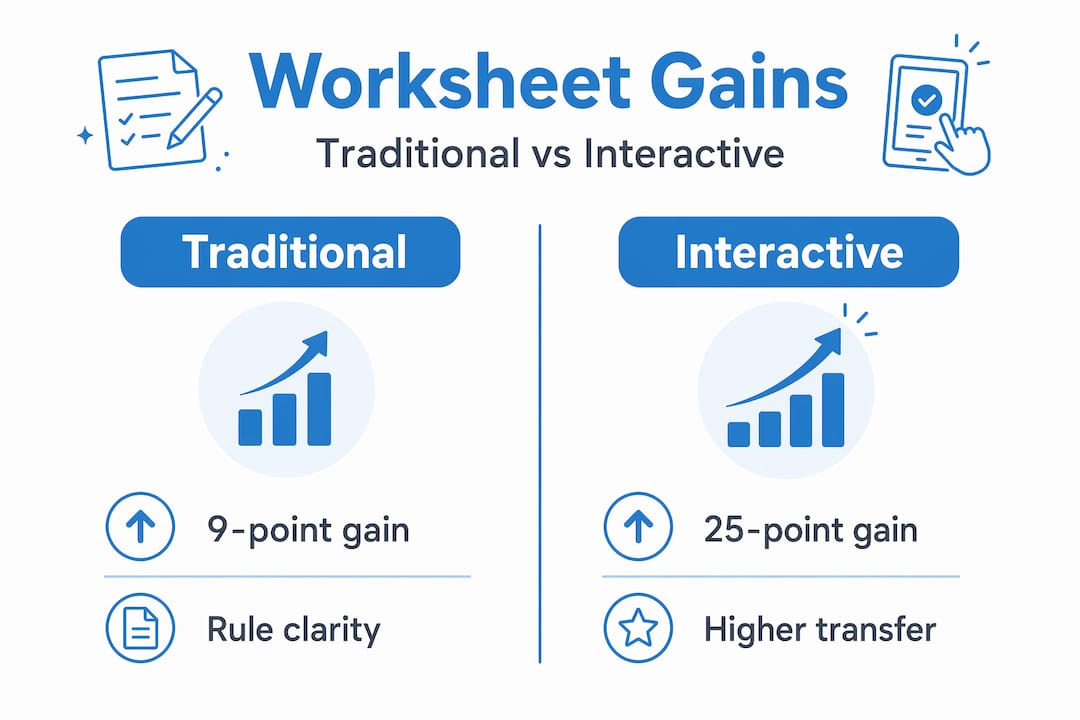
| Interactive/multimedia integrated | 54% | 79% | +25 points |
| Context-embedded writing tasks | 57% | 81% | +24 points |
Note: Figures are illustrative of reported trends in cited research, not a single study's exact data.
The gap between traditional and interactive formats is significant. A 25-point gain versus a 9-point gain represents a fundamentally different learning experience. The interactive format works because it keeps students cognitively active throughout the task rather than allowing them to fill in blanks on autopilot.
For homeschool settings, this translates well to daily editing cycles where students work through a short passage each morning, identifying errors, correcting them, and then writing one original sentence using the same structure. The routine is short, focused, and contextual. You can find interactive worksheet ideas that adapt well to both classroom and homeschool formats.
Key benefits of contextual and interactive grammar practice:
- Students see grammar as a tool for communication, not just a test subject
- Higher engagement reduces the passive, autopilot completion that plagues traditional worksheets
- Connecting grammar to reading and writing builds cross-skill transfer
- Interactive formats provide natural checkpoints for self-assessment
Practical applications: Classroom and homeschool routines that drive transfer
Theory is only useful when it becomes a routine you can actually run on a Tuesday morning. Here is how to build worksheet practice into daily instruction in ways that drive real transfer.
A five-step classroom routine:
- Introduce the concept with a mentor sentence or short passage from a text students know. Show the rule in action before asking students to practice it.
- Complete the worksheet with a clear time limit. Ten to fifteen minutes is usually enough for a focused practice set.
- Review two or three items as a class, focusing on the items most likely to reveal misconceptions. Ask students to explain their reasoning, not just their answers.
- Write original sentences using the target structure. Even two or three sentences push the skill from recognition to production.
- Apply in a draft or revision task later in the week. Ask students to find one place in their current writing where they can use the rule correctly.
Daily Grammar Practice programs used in many homeschool settings aim to teach grammar in context with daily editing cycles rather than as stand-alone worksheets. This approach works because it distributes practice across the week and keeps grammar connected to real text.
Checklist for aligning worksheets with lesson goals:
- Does this worksheet target a skill students will use in their current writing unit?
- Is there a feedback step built into the lesson plan?
- Will students have a chance to apply this rule in original writing within 48 hours?
- Does the worksheet format match the way students will use this skill in real writing?
Homeschool grammar curriculum guidance consistently recommends against using worksheets as isolated homework without follow-up. The worksheet is the practice rep. The follow-up discussion and writing application are the actual game.
Pro Tip: Use worksheet corrections as springboards for writing conferences. When a student consistently misses a particular type of item, bring that pattern into your next one-on-one writing conversation. Ask the student to find the same pattern in their own draft. That connection is where lasting learning happens.
You can build consistent premade worksheet routines around your curriculum calendar, and use planning worksheet cycles to structure practice across a full semester without starting from scratch each week.
Why most worksheet strategies miss the mark—and what actually drives lasting grammar learning
Here is the uncomfortable truth most articles about grammar worksheets avoid: the problem is not the worksheet. The problem is what we expect the worksheet to do on its own.
Teachers and homeschool parents often reach for worksheets because they are efficient. They cover a rule, they produce a score, and they feel like progress. But discrete grammar tests can improve even when writing-task performance does not. That is a striking finding. Students can get better at grammar tests while their actual writing stays exactly the same. Worksheet-based grammar practice needs explicit connection to drafting and revision routines to generalize to real writing.
The fix is not to abandon worksheets. It is to stop treating worksheet completion as the endpoint. Every worksheet should be a diagnostic tool, a conversation starter, and a bridge to writing practice. That requires a small shift in how you plan lessons, but the payoff is significant.
Adding interactive or multimedia components to worksheet-like tasks is associated with large gains and high satisfaction. This is not just about making worksheets more fun. It is about keeping students cognitively engaged so that the rule actually gets processed rather than just filled in. When students interact with grammar through video, discussion, or editing real text, they are building a mental model of the rule, not just a conditioned response to a worksheet format.
The most effective grammar instruction we have seen combines three things: structured worksheet practice for rule clarity, immediate feedback and discussion for error correction, and explicit writing application for transfer. None of those three elements works well without the other two. Focus on evidence of transfer, not just worksheet completion, and you will see a real difference in how your students write.
Explore innovative worksheet formats that push beyond the traditional fill-in-the-blank model and give students more ways to engage with grammar in context.
Take your grammar worksheets further with Worksheet Wonder Pro
You now have a clear picture of what makes grammar worksheets work and where most routines fall short. The next step is putting those strategies into practice with tools built specifically for teachers and homeschool parents.

Worksheet Wonder Pro gives you a fast, flexible way to build the kind of research-backed grammar practice described throughout this article. Whether you need a custom worksheet aligned to your current writing unit or a ready-to-use set for a specific skill, the platform has you covered. Use the grammar worksheet creator to build targeted activities with feedback built in, or browse premade grammar resources to find worksheets you can use today. Stop settling for isolated practice and start building routines that actually move the needle on writing quality.
Frequently asked questions
Why do students sometimes perform well on grammar worksheets but poorly on writing tasks?
Because worksheet practice often isolates grammar rules, students may not transfer that knowledge automatically to writing unless worksheets are aligned with drafting or revision routines. This silo problem in grammar instruction is well documented and requires intentional instructional design to overcome.
What type of feedback makes grammar worksheets more effective for learning?
Immediate feedback and follow-up activities after worksheet completion help address misconceptions and reinforce learning. Integrating feedback into grammar practice and ensuring the activity triggers further practice is a key recommendation from education researchers.
Are interactive or multimedia grammar worksheets more effective than traditional formats?
Research shows interactive and multimedia worksheets can improve engagement and grammar proficiency, though evidence is limited and context matters. Interactive grammar interventions have reported sizable pre-to-post gains on grammar proficiency measures in several studies.
How can homeschool routines incorporate grammar worksheets to foster language skills?
Daily editing cycles and teaching grammar in context with short, integrated worksheet activities support lasting language gains. Daily Grammar Practice approaches used in homeschool programs prioritize contextual practice over stand-alone worksheet assignments.